Danes will tell you, with some pride, that their language sounds like someone talking with a hot potato in their mouth. They are not wrong. Danish spelling bears a loose relationship to Danish sound, whole consonants disappear in normal speech, and the capital city’s own name comes out as something like “kuh-ben-HOWN”. None of that means you should skip learning a few words. The right Danish phrases for travellers are not the ones in the back of a phrasebook — they are the dozen or so words that make shops, bakeries, bars and doors work, and about twenty-five more that are simply nice to have.
Below are forty, grouped by where you will actually use them, with pronunciations written for English speakers rather than linguists. They are approximations. Danish has sounds English does not, and the goal is to be understood, not to pass as local. For the social rules that sit behind the words, see our guide to Danish etiquette and customs.
First, the Word That Does Not Exist
There is no Danish word for “please”. This is the single most useful fact on the page, because it explains both how to be polite in Danish and why Danes can sound curt in English.
The work “please” does in English is done in Danish by tak — thanks — tacked onto the end of a request. “En kaffe, tak” is “a coffee, thanks”, and it is exactly as polite as “a coffee, please”. For something more formal, you soften the verb: “Må jeg få en kaffe?” — “may I have a coffee?” There is a phrase, vær så venlig, that translates roughly as “be so kind”, but it is stiff, rarely heard in a shop, and in the wrong tone of voice it sounds sarcastic. Leave it alone.
So when a Dane says “give me the salt” in English, they are not being rude. They have translated a perfectly courteous Danish sentence into English and found no “please” to put in it.
The Ten You Will Use Every Day
| Danish | Meaning | Say it like |
|---|---|---|
| Hej | Hi, hello | hi |
| Hej hej | Bye (casual) | hi-hi |
| Godmorgen | Good morning | go-MORN |
| Tak | Thanks — and the stand-in for please | tahk, short and clipped |
| Mange tak | Thanks very much | MANG-uh tahk |
| Tusind tak | A thousand thanks | TOO-sin tahk |
| Ja | Yes | ya |
| Nej | No | nigh |
| Undskyld | Sorry, excuse me | OON-skul |
| Værsgo | Here you are, help yourself | VERS-go |
Hej is the workhorse. It is hello to a shop assistant, a friend, the bus driver and your boss, and doubled — hej hej — it is the standard goodbye. You will hear “hej hej” sung out at the end of every transaction in the city. Say it back.
Undskyld covers both “sorry” and “excuse me”, which makes it the word for getting past someone on the metro, for attracting a waiter, and for apologising when you have walked into a bike lane. You will use it more than you expect. Værsgo is what you will hear, not say: it is what the person behind the counter says as they hand something over, and what a host says to invite you to start eating.
Ordering Food and Drink
| Danish | Meaning | Say it like |
|---|---|---|
| Må jeg få…? | May I have…? | moh yai foh |
| En kaffe, tak | A coffee, thanks | en KAF-uh, tahk |
| En stor fadøl | A large draught beer | en stor FATH-url |
| Regningen, tak | The bill, please | RYE-ning-en, tahk |
| Kan jeg betale med kort? | Can I pay by card? | kan yai beh-TAY-luh meth kort |
| Kvittering | Receipt | kvi-TEH-ring |
| Skål | Cheers | skohl |
| Tak for mad | Thanks for the food | tahk for math |
| Velbekomme | You are welcome (after a meal) | VEL-beh-kom-uh |
| Postevand | Tap water | POS-teh-van |
Two of these save real money. En stor fadøl gets you the house draught at house price rather than whichever tap the bartender reaches for, a small trick our guide to beer prices explains in kroner. And postevand is the word for tap water, which is excellent in Copenhagen and free if you ask for it by name rather than accepting the bottled water you get offered.
The bakery is where most people first try any of this, and it is the kindest place to do it. Point, say “en kanelsnegl, tak” — a cinnamon swirl, thanks — and you will almost certainly be answered in English, cheerfully, with a værsgo as the bag comes over. That is a successful exchange. Our bakery guide covers where to practise, and the pastry guide covers what to point at.
Tak for mad and velbekomme are a pair. Guests say the first to whoever cooked, at the end of the meal, and the cook answers with the second. If you are ever invited into a Danish home, this is the exchange that matters most.
Getting Around
| Danish | Meaning | Say it like |
|---|---|---|
| Hvor er…? | Where is…? | vor air |
| Toilet | Toilet | toy-LET |
| Indgang | Entrance | IN-gang |
| Udgang | Exit | OOTH-gang |
| Billet | Ticket | bi-LET |
| Højre | Right | HOY-ruh |
| Venstre | Left | VEN-struh |
| Lige ud | Straight on | LEE-uh ooth |
Most of these you will read rather than say. Indgang and udgang are on every museum, station and supermarket door, and udgang is the one worth memorising because metro exits are signposted in Danish first. Billet turns up on every ticket machine and in the transport app, which is covered in our public transport tickets guide and the metro guide.
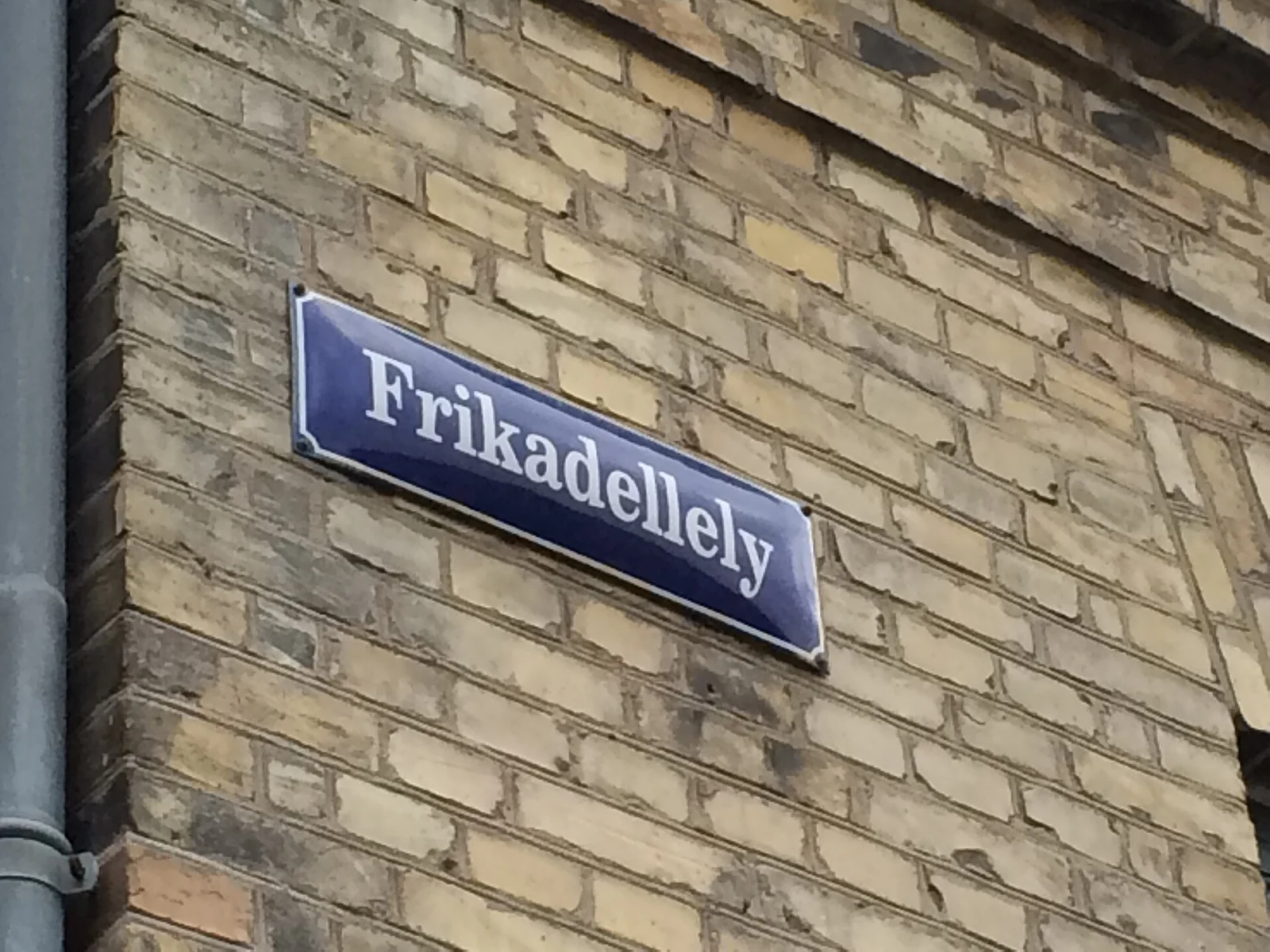
Street names are the other thing you will read constantly, and they are worth a moment because they are often funnier than they look. Gade is street, vej is road, stræde is lane, torv is square and plads is place. Put together with the right first half, you get the enamel sign in the photograph above: Frikadellely, a real street near Tagensvej, which a Dane will translate for you, deadpan, as “meatball shelter”.
Shops, Doors and Signs
| Danish | Meaning | Say it like |
|---|---|---|
| Åben | Open | OH-ben |
| Lukket | Closed | LOOK-uh |
| Tryk | Push | trook |
| Træk | Pull | trek |
| Tilbud | Special offer | TIL-booth |
| Kasse | Checkout, till | KASS-uh |
| Pant | Bottle deposit | pant |
| Apotek | Pharmacy | ah-po-TAYK |
The door pair is the one that catches everyone. Tryk means push and træk means pull, which is precisely backwards from what an English speaker’s eye tells them — træk looks like it should mean track or trek, and tryk looks like nothing at all. Copenhagen’s shop doors are labelled with these and nothing else, so for your first day or two you will pull a door marked push at least once. Everyone does. Now you will not.

Tilbud is on every supermarket shelf edge and means the thing is on offer. Pant is the deposit printed on your receipt next to every can and bottle, refundable at the machine by the door — the money guide covers how paying works generally. And apotek matters because Danish pharmacies are not marked with the word “pharmacy”; if you need one at night, that is the word to look for on the sign.
When It Goes Wrong, and When It Goes Well
| Danish | Meaning | Say it like |
|---|---|---|
| Taler du engelsk? | Do you speak English? | TAY-ler doo ENG-elsk |
| Jeg forstår ikke | I do not understand | yai for-STOR ICK-uh |
| Hyggeligt | Cosy, nice, lovely | HOO-guh-lit |
| Farvel | Goodbye (fuller than hej hej) | far-VEL |
You will almost never need the first two. English proficiency in Denmark is among the highest in the world, and the standard experience is that a Dane will hear your accent and switch to English before you finish the sentence. That is not a rebuke; it is efficiency. Our page on English in Copenhagen covers exactly how far it gets you, which is nearly everywhere.
Hyggeligt is the adjective form of hygge, and it is the most useful compliment in the language. A good dinner, a pleasant bar, a nice evening, a friendly conversation — all hyggeligt. “Det var hyggeligt”, that was lovely, is the right thing to say as you leave almost anywhere. Our hygge guide covers the concept properly.
How to Actually Pronounce Danish (Roughly)
The honest advice is: do not try too hard. A handful of rules gets you close enough.
- The soft d. A d after a vowel is barely there — closer to the th in “the”, said lazily. Mad (food) is “math”. This is why rødgrød med fløde, a berry pudding with cream, is the phrase Danes delight in making foreigners attempt. You will fail. So does everyone.
- Swallowed endings. Final letters often vanish. Lukket is “LOOK-uh”; hyggeligt loses its g and t. If a word looks long, say less of it.
- ø, å and æ. Ø is close to the vowel in “fur”, Å is close to the vowel in “more”, Æ is close to the e in “bed”. They are separate letters that come at the end of the alphabet, after z, which is why Østerbro and Århus sit at the very back of a Danish index.
- Hv sounds like v. Hvor is “vor”, hvad is “va”. The h is silent.
- Stress the first syllable. Most Danish words carry the weight at the front. When in doubt, lean on the start and trail off.
One place-name correction worth making: Danes do not say “Copen-HAY-gen” or “Copen-HAH-gen”. The Danish name is København, roughly “kuh-ben-HOWN”, and it means merchants’ harbour. Nobody will correct your English pronunciation, but saying it the Danish way once, deliberately, gets a smile every time.
A Word on Numbers

Danish counting from fifty to ninety is famously strange. Fifty is halvtreds, derived from an old system of counting in twenties that even most Danes cannot explain, and seventy and ninety follow the same logic. You do not need to learn any of it. Every price in Copenhagen is displayed, card payment is near-universal, and a market trader at Torvehallerne will simply show you the screen. Just know that if someone reads a price aloud and it sounds like nothing you learned at school, that is why.
Frequently Asked Questions
How do you say thank you in Danish?
Tak, pronounced “tahk”, short and clipped. Mange tak is thanks very much and tusind tak, literally a thousand thanks, is warmer still.
Is there a word for please in Danish?
Not really. Danes add tak (thanks) to the end of a request — “en kaffe, tak” — or soften it with “må jeg få…?”, meaning “may I have…?”. The phrase vær så venlig exists but is stiff and rarely used in shops.
How do you say hello and goodbye in Danish?
Hej (“hi”) for hello and hej hej for goodbye in almost every situation. Farvel is a fuller goodbye, and godmorgen is good morning.
Do I need to speak Danish in Copenhagen?
No. English is spoken almost universally and most Danes will switch to it as soon as they hear an accent. A few words — hej, tak, undskyld — are appreciated precisely because nobody expects them.
What does skål mean?
Cheers. It is pronounced “skohl”, and Danish custom is to make eye contact with each person as you raise your glass and again before you put it down.
What is the hardest Danish phrase to say?
Rødgrød med fløde, a red berry pudding with cream. It is stacked with soft d’s and ø sounds, and Danes enjoy asking foreigners to try it.
Related Reading
- Danish etiquette and customs the eighteen social rules these words sit inside.
- English in Copenhagen how far you get without any Danish at all.
- Tipping in Copenhagen what to do when the regning arrives.
- The best smørrebrød in Copenhagen the menu you will most want to read.
- Copenhagen travel tips the practical layer underneath the language.
Photo Credits
- A blue enamel Copenhagen street sign reading Frikadellely on a yellow brick wall: photo by Kim Bach, Frikadellely street sign – Tagensvej 83-85 – Copenhagen – Denmark.JPG, CC BY-SA 4.0
Final Thoughts
If you learn five words, make them hej, tak, undskyld, tryk and træk. The first three cover politeness; the last two will stop you pulling on a door marked push in front of a queue. Everything else on this page is a bonus.
And remember what the missing “please” tells you. Danish politeness is plainer than English politeness — less decoration, more directness, a great deal of thanking. Say tak often, say hej hej on the way out, and you will be doing it better than most visitors, in a city that will answer you in English anyway.