Hans Christian Andersen arrived in Copenhagen in September 1819, aged fourteen, with almost nothing to his name and a plan to become famous on the stage. He never really left. Over the next fifty-six years he moved between rented rooms, a hotel and three houses on the same canal, and the city still carries his traces on its façades, in its gardens and in a quiet corner of a Nørrebro cemetery. A Hans Christian Andersen Copenhagen walk is one of the best free things to do in the city, and it takes you through most of the old town on the way.
This walk links the places that matter in a sensible order: his statue by City Hall, his early lodgings, the hotel on Kongens Nytorv, the three Nyhavn houses, the Little Mermaid, the statue in the King’s Garden and, finally, his grave. Allow a relaxed half-day for the central section, plus a bus or metro ride to the cemetery. Dates come from the H.C. Andersen Centre at the University of Southern Denmark and other official sources, and were checked in October 2026.
The Walk at a Glance
| Stop | Where | Andersen connection |
|---|---|---|
| 1 | H.C. Andersens Boulevard, by City Hall | Bronze statue by Henry Luckow-Nielsen |
| 2 | Vingårdsstræde 6 | His attic room, 1827–1828 |
| 3 | Kongens Nytorv | Lived at the Hotel du Nord, 1838–1847 |
| 4 | Nyhavn 20 | Wrote his first fairy tales here, 1834–1838 |
| 5 | Nyhavn 67 | His longest Nyhavn stay, 1848–1865 |
| 6 | Nyhavn 18 | His last city address, 1871–1875 |
| 7 | Langelinie | The Little Mermaid, unveiled 1913 |
| 8 | Kongens Have | August Saabye’s seated statue, 1880 |
| 9 | Assistens Kirkegård, Nørrebro | His grave |
Who He Was, in One Paragraph
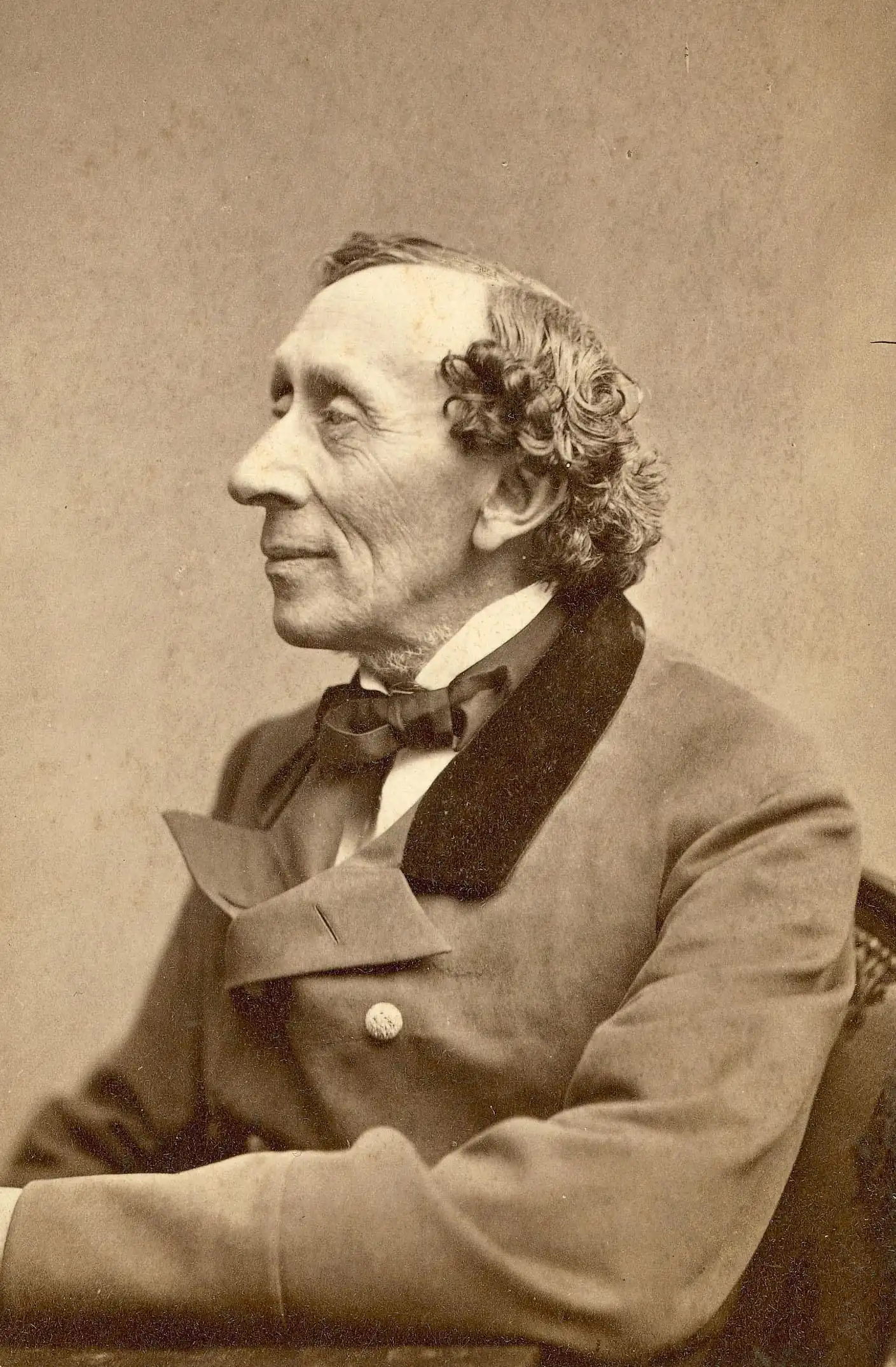
Andersen was born in Odense on 2 April 1805, the son of a shoemaker, and came to Copenhagen on 6 September 1819 to try his luck in the theatre. It did not work out on stage, but with the help of patrons, above all the Collin family, he got an education and turned to writing: poems, novels, plays, travel books and, from 1835, the fairy tales that made him one of the most translated authors in the world. He never married, travelled restlessly across Europe, and always came back to Copenhagen. He died on 4 August 1875 at Rolighed, the Melchior family’s villa in Østerbro, aged seventy.
Stop 1: the Statue on H.C. Andersens Boulevard

Start at City Hall Square, Rådhuspladsen. On the edge of the square, beside the busy boulevard that carries his name, a large bronze Andersen sits with a book and a walking stick, his head turned towards Tivoli across the road. The statue is by the sculptor Henry Luckow-Nielsen and it is a favourite spot for a photograph.
Tivoli itself opened in August 1843, when Andersen was in his late thirties and already a well-known writer, so the gardens across the road were part of his Copenhagen too. Our Tivoli guide covers the park today.
On the square, the Hans Christian Andersen Experience at Rådhuspladsen 57 (Ripley’s own site spells it “H.C. Anderson Experience”) is a commercial attraction run by Ripley’s, a walk through the fairy tales rather than a museum about the man himself. If you do go, check Ripley’s own site for the day’s hours and prices.
Stop 2: Vingårdsstræde 6, the Attic Years
Walk up Strøget towards Kongens Nytorv and turn into Vingårdsstræde, a short street just before the square. At number 6, the young Andersen rented a small attic room on the third floor in 1827–1828, while he was beginning to write.
The building is easy to walk past. That is rather the point of this stop: it shows how close the poor student lived to the grand square around the corner, and how long the climb was from an attic in a side street to the hotels and salons he would later frequent.
Stop 3: Kongens Nytorv and the Hotel du Nord
Kongens Nytorv, the King’s New Square, is the hinge of this walk. From 1838 to 1847, Andersen lived at the Hotel du Nord on the square, a move that marked how far he had come. The hotel has gone, but the department store that took its name in 1879, Magasin du Nord, still stands on Kongens Nytorv.
Stand on the square and turn east: Nyhavn opens directly off it, and the next three stops are a few minutes’ walk away.
Stops 4 to 6: Andersen’s Three Nyhavn Houses
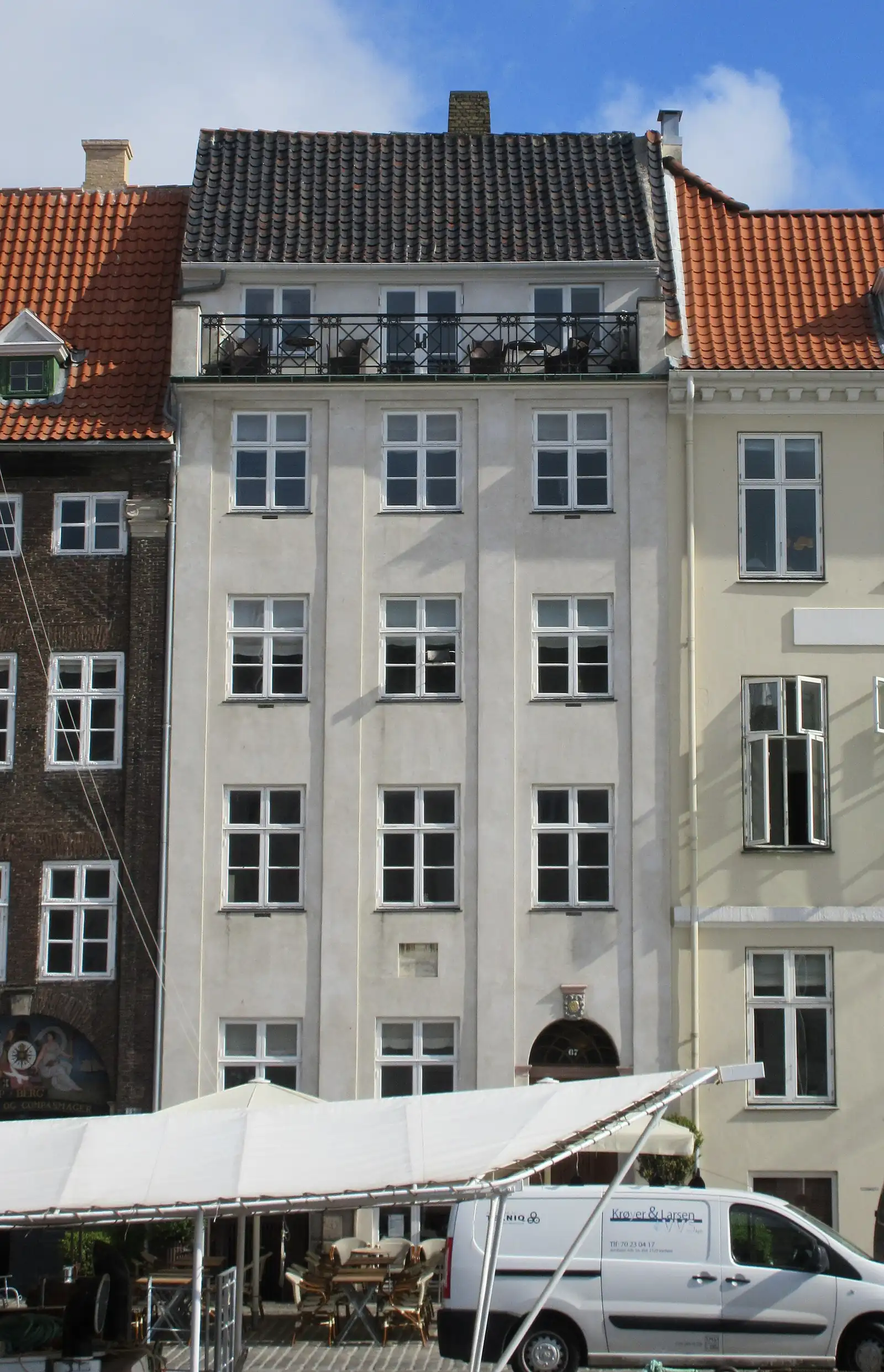
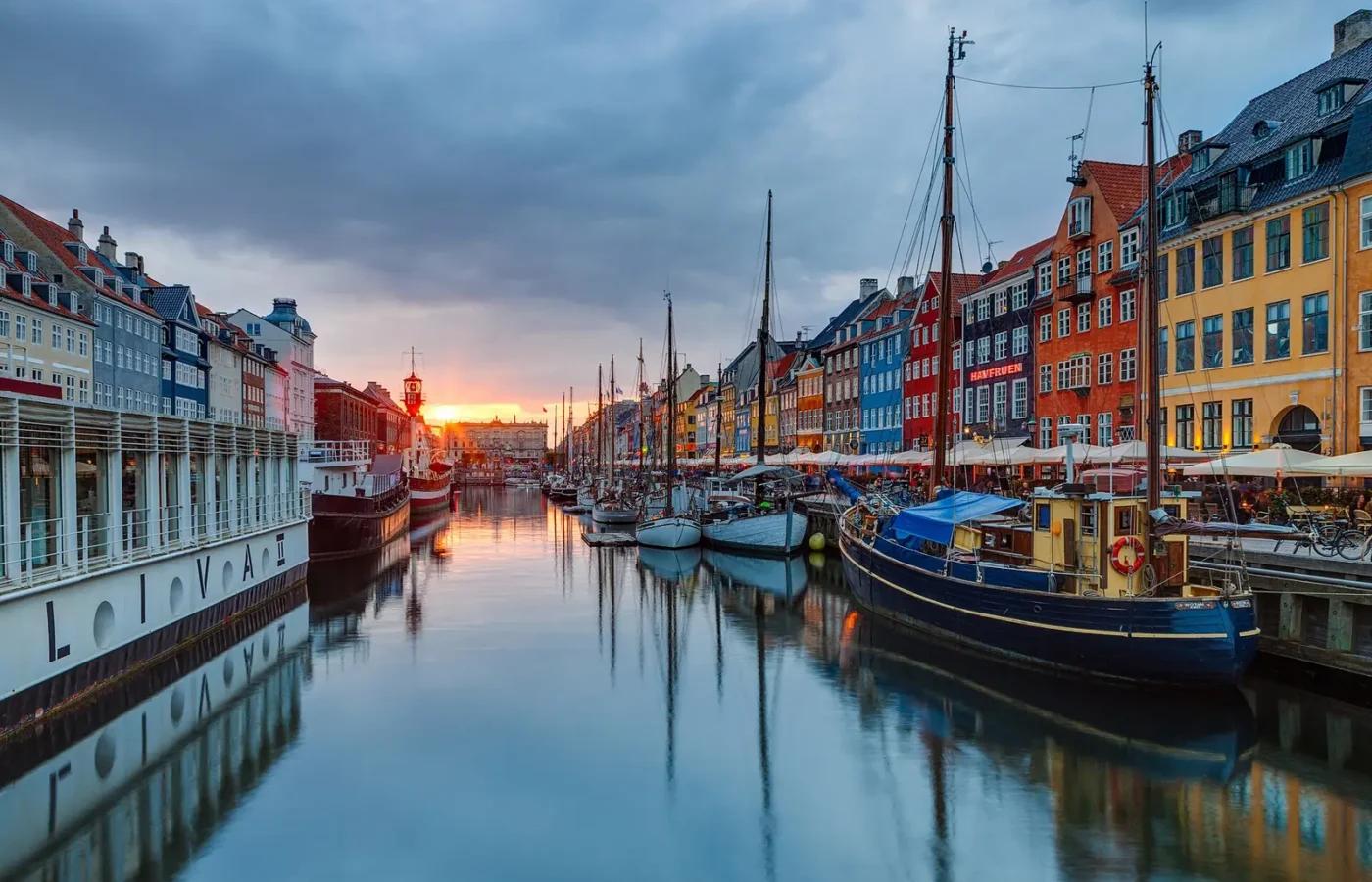
Andersen lived in Nyhavn at three different addresses, for about twenty-five years in all. Walk along the canal and you can stand outside each of them.
Nyhavn 20 (1834–1838)
Andersen moved into rooms on the second floor here on 1 September 1834, and it was at Nyhavn 20 that he wrote his first fairy tales, published in May 1835. This is the address where the stories that would make him world-famous began. A plaque on the façade marks it. He left on 1 December 1838 for the Hotel du Nord.
Nyhavn 67 (1848–1865)
After the hotel years he came back to the canal, and stayed. Andersen lived at Nyhavn 67 from 1848 to 1865, seventeen years, far longer than at any other address in the city. This is the house of his middle age and fame, the period when he was travelling across Europe and returning to Copenhagen as a celebrity.
Nyhavn 18 (1871–1875)
His last city address was on the first floor of Nyhavn 18, from 23 October 1871. By then he was old and increasingly ill, and in July 1875 he left to stay with his friends the Melchiors at Rolighed in Østerbro, where he died that August.
A practical note: Nyhavn’s quayside is lined with restaurant terraces in summer, and the house numbers can be hard to spot behind the umbrellas. Walk on the far side of the canal for the best view of the façades, then cross back for a closer look.
Stop 7: the Little Mermaid
From Nyhavn, follow the harbour north past Amalienborg to Langelinie, where the Little Mermaid sits on her rock. Andersen’s tale was published in 1837; the statue came much later. It was commissioned in 1909 by the brewer Carl Jacobsen, made by the sculptor Edvard Eriksen, and unveiled on 23 August 1913, nearly forty years after Andersen’s death. She is only 1.25 metres tall, which surprises almost everyone.
This is the one stop on the walk that is about the stories rather than the man, and it is a detour: allow extra time for the walk out along the harbour and back. On the way, the ramparts of Kastellet are a pleasant short cut away from the crowds.
Stop 8: the Statue in Kongens Have
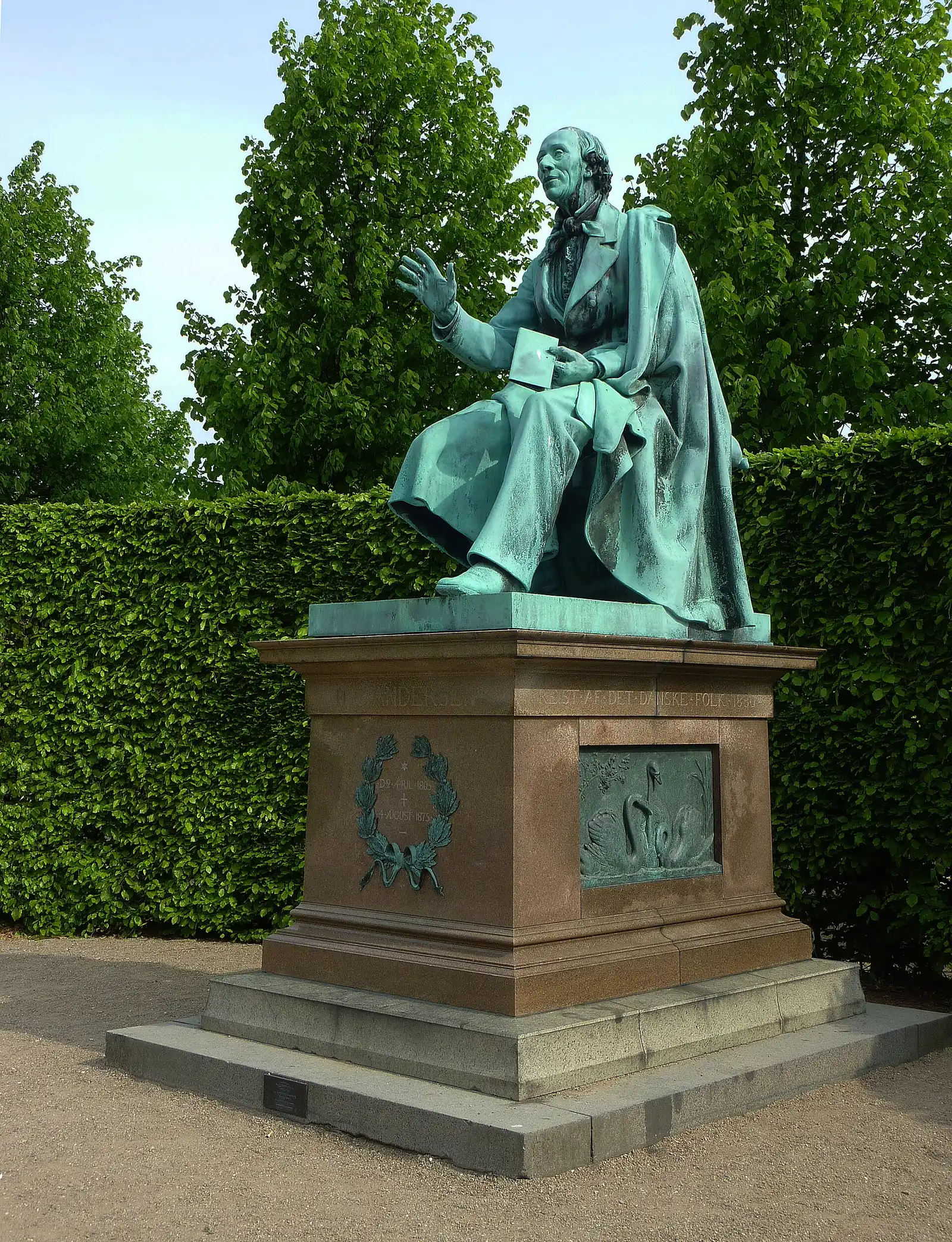
Cut back inland to Kongens Have, the King’s Garden around Rosenborg Castle. At the northern end of the garden sits the older of the city’s two big Andersen statues: August Saabye’s bronze, unveiled on 26 June 1880, five years after the writer’s death, showing him seated with a book.
It is the best place on the walk to stop for a while. The garden is free, the lawns are made for a picnic, and the statue is a favourite with children who climb up beside it. For opening hours and the rest of the garden, see our guide to the best parks in Copenhagen.
Stop 9: the Grave in Assistens Kirkegård
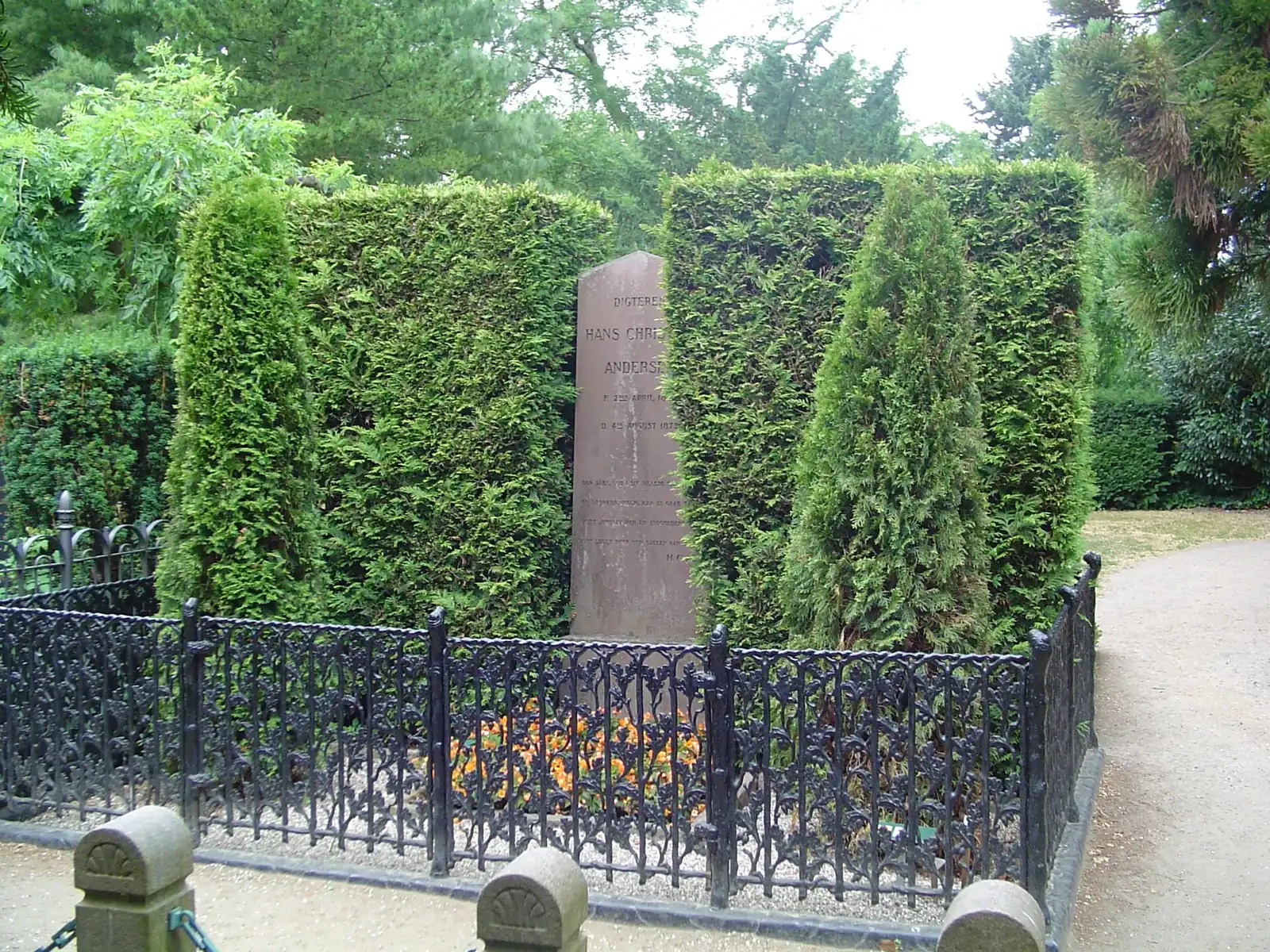
The last stop is a ride rather than a walk from the centre. Assistens Kirkegård, in Nørrebro, is a working cemetery that also serves as one of the city’s favourite green spaces. The main entrance is at Kapelvej 2; check Rejseplanen for the quickest bus or metro from where you are. It is open from 07:00, until 19:00 from October to March and until 22:00 from April to September.
Andersen is buried in the plot of the Collin family, the patrons who had supported him since his teens. Here is the detail almost every visitor misses: the stone you see is not the original. The first marker, of red sandstone from Nexø on Bornholm, stood on the grave from 1875 until it was damaged in 1983, and was replaced with a replica. The original is now on display at H.C. Andersens Hus, the Andersen museum in Odense.
The cemetery holds other famous names, among them Søren Kierkegaard and Niels Bohr, and the signposting inside helps you find them. Please remember it is still a place of mourning: sitting on the grass is fine in the park sections, but not among the graves.
If You Have More Time
The serious Andersen museum is not in Copenhagen but in his birthplace, Odense, on the island of Funen. H.C. Andersens Hus sits a few minutes’ walk from his childhood home. It makes a rewarding day trip if Andersen is the reason you came to Denmark; check hcandersenshus.dk for opening hours and tickets, and DSB or Rejseplanen for trains. Our day trips from Copenhagen guide covers the options.
For a guided version of some of this route, several of the free walking tours that start at Rådhuspladsen pass the Andersen statue and Nyhavn; our walking tours guide compares them.
Getting Between the Stops
Stops 1 to 6 are an easy walk, almost all of it on pedestrian streets and the Nyhavn quay. The metro helps with the rest. Rådhuspladsen and Kongens Nytorv are both stations on the City Circle line, so if your feet give out you can ride between the first and third stops. For the Little Mermaid, Østerport station is the nearest on the M3 and M4 lines, and from Langelinie it is a walk of about a quarter of an hour. Kongens Have is a short walk from Nørreport, on the M1 and M2 and the S-trains. Every journey within the centre is two zones, 24 DKK for a single in 2026; our guide to Copenhagen public transport tickets explains the options.
If you would rather not walk at all, the Nyhavn and harbour section can be done from the water. The harbour buses stop at Nyhavn and at Nordre Toldbod, north of Amalienborg, on an ordinary two-zone ticket.
Tips for the Walk
- Go in the morning. Nyhavn and the Little Mermaid are far calmer before about 10:00, and the light on the Nyhavn façades is better.
- Do it in reverse with children. Start at the statue in Kongens Have, then Nyhavn and the Mermaid, and save Tivoli and the Rådhuspladsen statue for the end of the day.
- Read a story first. “The Little Mermaid”, “The Tinderbox” and “The Little Match Girl” are short, and knowing them makes the stops far more vivid.
- Combine it. The central section overlaps with most of our one-day itinerary, so it is easy to fold into a first day in the city.
Frequently Asked Questions
Where did Hans Christian Andersen live in Copenhagen?
At several addresses, including an attic room at Vingårdsstræde 6 (1827–1828), the Hotel du Nord on Kongens Nytorv (1838–1847) and three houses in Nyhavn: number 20 (1834–1838), number 67 (1848–1865) and number 18 (1871–1875).
Which Nyhavn house did Andersen live in?
Three of them. He wrote his first fairy tales at Nyhavn 20, lived longest at Nyhavn 67, from 1848 to 1865, and spent his last years in the city at Nyhavn 18. A plaque marks Nyhavn 20.
Where is Hans Christian Andersen buried?
In Assistens Kirkegård in Nørrebro, in the Collin family plot. The cemetery is open daily from 07:00, until 19:00 in winter and 22:00 in summer.
Is there a Hans Christian Andersen museum in Copenhagen?
There is a commercial attraction, the Hans Christian Andersen Experience, run by Ripley’s, on Rådhuspladsen. The main Andersen museum, H.C. Andersens Hus, is in his birthplace, Odense.
Is the Hans Christian Andersen walk free?
Yes. Every stop on this walk is free: the statues, the Nyhavn houses from the outside, the Little Mermaid, Kongens Have and the cemetery. You only pay if you take public transport to Assistens Kirkegård.
When did Hans Christian Andersen die?
On 4 August 1875, aged seventy, at Rolighed, the home of his friends the Melchior family in Østerbro, Copenhagen.
Related Reading
- Free things to do in Copenhagen for more days out that cost nothing.
- Copenhagen with kids for turning the fairy tales into a family day.
- The old town, Indre By where most of this walk takes place.
- Danish etiquette and customs for the culture Andersen wrote about.
Photo Credits
- Old wooden boats moored along Nyhavn canal at sunset: photo by Moahim, 2018 – Nyhavn on sunset.jpg, CC BY-SA 4.0
- Hans Christian Andersen in profile, photographed by Thora Hallager in 1869: photo by Thora Hallager, Hans Christian Andersen by Thora Hallager 1869.jpg, Public domain
- The white townhouse at Nyhavn 67 between its neighbours on the canal: photo by Ramblersen, Nyhavn 67.jpg, CC BY-SA 4.0
- August Saabye’s seated bronze statue of Hans Christian Andersen in Kongens Have: photo by RAYANDBEE from United Kingdom, Kongens Have – H. C. Andersen.jpg, CC BY 2.0
- Hans Christian Andersen’s grave stone behind iron railings in Assistens Cemetery: photo by Unknown author, H. C. Andersen grave 2.jpg, Public domain
Final Thoughts
Andersen’s Copenhagen is not a museum. It is a set of ordinary buildings, two statues and a grave, and the pleasure of the walk is in how unremarkable most of it looks: an attic window on a side street, a house number on a crowded quay, a modest stone behind iron railings. The stories travelled the world. The man mostly stayed here, within a short walk of the canal.
Walk it slowly, read a tale on a bench in Kongens Have, and finish in the quiet of Assistens with the city’s traffic a long way off.
Dates and opening hours checked October 2026 against the H.C. Andersen Centre at the University of Southern Denmark, Copenhagen Municipality, VisitCopenhagen and the museums’ own sites.