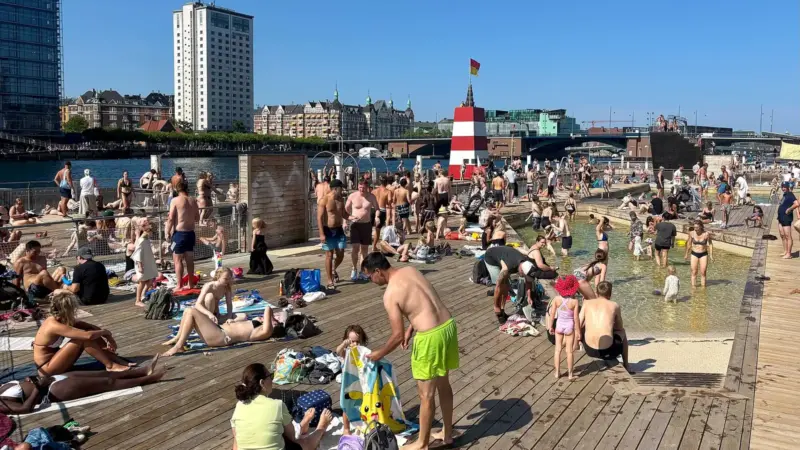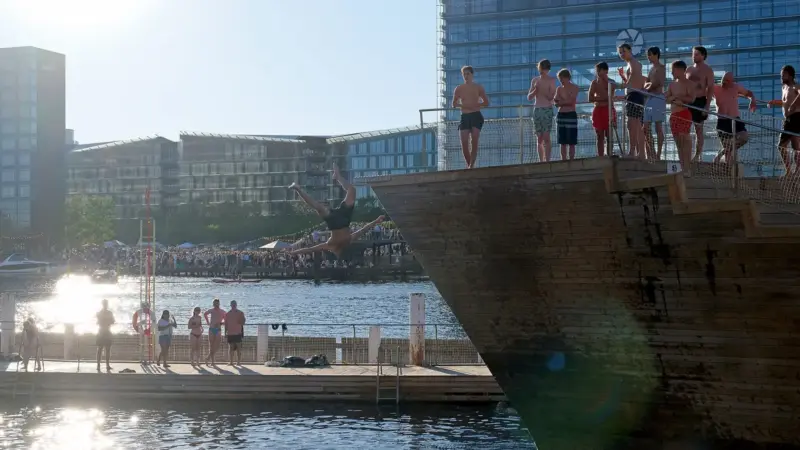
There is a moment, about fifteen minutes after you step onto the M2 metro in the centre of Copenhagen, when the train climbs out of its tunnel, the doors open at Amager Strand, and you can smell the sea. That is how close the city’s beaches are. Most of the best beaches near Copenhagen are a metro or S-train ride from your hotel, and two of the finest in Denmark are an easy day trip up the coast. The trick is knowing which one suits the afternoon you have in mind, and which way it faces.
This guide ranks nine swims within about an hour of the city, seven of them reachable in half an hour or less by public transport, with how to get there, who each one suits and an honest verdict on each. Then it covers the thing almost nobody tells you, which is where the sun will be at five o’clock, along with water quality, jellyfish and when to go. Details were checked in October 2026.
The Best Beaches Near Copenhagen at a Glance
| Rank | Beach | Getting there | Time from the centre | Best for |
|---|---|---|---|---|
| 1 | Amager Strandpark | M2 metro to Amager Strand or Femøren | A short metro ride | An easy, all-round beach day |
| 2 | Bellevue, Klampenborg | C-line S-train to Klampenborg | A short train ride | Looks, history and a forest next door |
| 3 | Tisvildeleje | S-train to Hillerød, then the local train | About 1 hour 15 minutes | A proper seaside day out |
| 4 | Hornbæk | Train to Helsingør, then the local train | About 1 hour 30 minutes | A seaside village and wide sand |
| 5 | Kastrup Søbad | M2 metro to Kastrup | A short metro ride | A swim with architecture |
| 6 | Køge Bugt Strandpark | A-line S-train to Brøndby Strand, Ishøj or Hundige | About 25–35 minutes | Space, quiet and the ARKEN museum |
| 7 | Ribersborg, Malmö | Train to Malmö, then bus or a walk | About 40 minutes by train, plus a bus or a walk | Sunsets and a historic sauna |
| 8 | Svanemøllestranden | S-train to Svanemøllen | About 10 minutes | A quick swim with small children |
| 9 | Charlottenlund | S-train to Charlottenlund, then a walk | A short train ride, then a walk | A small beach and a fort |
How We Ranked Them
The ranking weighs the quality of the sand and the water, how easy it is to get there and back without a car, how crowded it gets, and what there is to do once you have dried off. A beach that takes an hour and a half to reach has to be very good to beat one that is fifteen minutes away, and two of them are. If you only want a quick dip rather than a beach, the harbour is closer still; our ranking of the Copenhagen harbour baths covers those.
The Nine Beaches, Ranked
1. Amager Strandpark: the city’s beach
Copenhagen’s main beach has been a park since 1934, but what you see today dates from 2005, when a two-kilometre artificial island was built offshore with a sheltered lagoon behind it. The result is 4.6 kilometres of sand, with the open Øresund on the island’s seaward side and calm, shallow lagoon water on the other, which warms up faster and is ideal for small children. The Øresund Bridge sits on the southern horizon, and there are jetties, kiosks and plenty of room to spread out.
It is the easiest beach day in the city: the M2 metro stops at Amager Strand and Femøren, each a short walk from the sand, about fifteen minutes from Kongens Nytorv. Our metro guide has the tickets. The only drawback is its popularity on hot weekends, when the area by the stations is busy; walk a few minutes further along the island and you will find space.
Verdict: the best all-round beach near Copenhagen, and the one to choose if you are not sure which to choose.
2. Bellevue, Klampenborg: the beautiful one
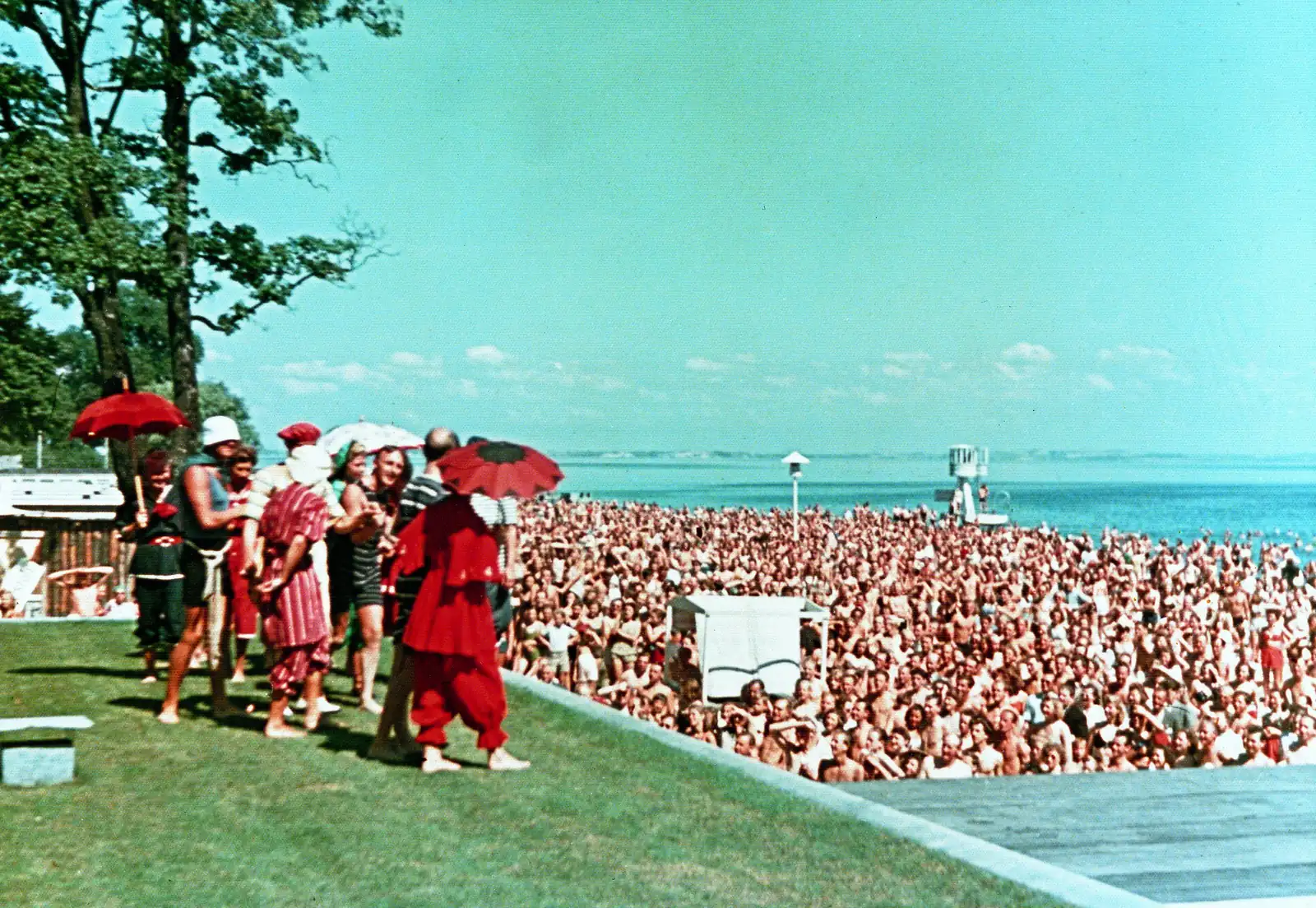
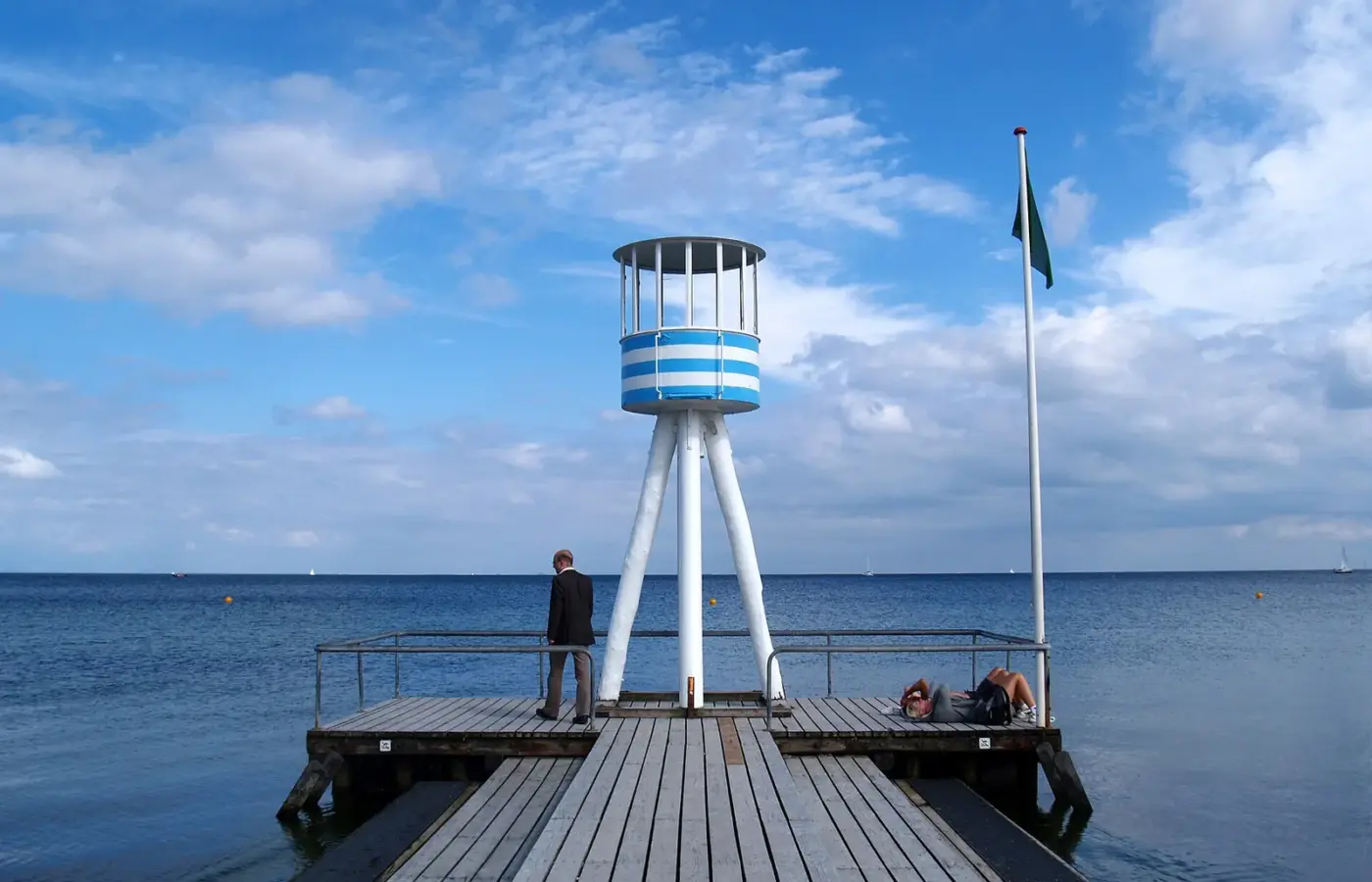
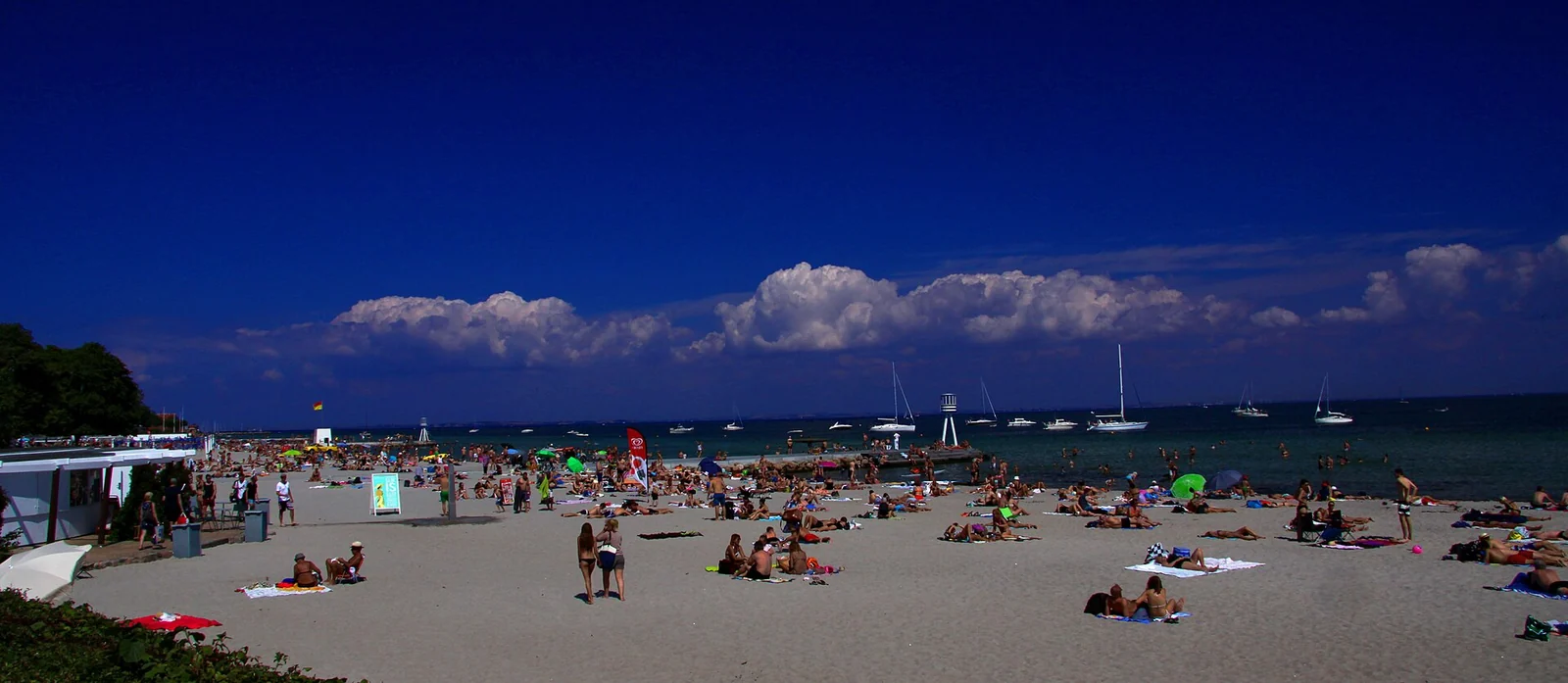
Bellevue is one of Copenhagen’s best-loved and most stylish beaches, and it has been open since 1932. In the 1930s Arne Jacobsen designed its blue-and-white striped lifeguard towers, kiosks and changing cabins, along with the Bellavista housing and Bellevue theatre across the road, and the towers are still there. The beach itself is a long curve of sand facing the Øresund, with a grassy slope behind for picnics.
Take the C-line S-train to Klampenborg, the end of the line, and walk a few minutes to the sand. The bonus is what is next door: Dyrehaven, the royal deer park, starts behind the station, so you can combine a swim with a walk among the deer, and in summer Bakken, the old amusement park, is at the forest’s edge; see our Bakken guide. On hot weekends Bellevue is packed, so come early or on a weekday.
Verdict: the prettiest beach within easy reach and the best one to combine with something else. Just not at two on a sunny Saturday.
3. Tisvildeleje: the seaside escape
Tisvildeleje, on the north coast of Zealand, is the beach Copenhageners escape to when they want a real seaside day rather than a city beach. It is a summer village of thatched houses and ice-cream shops behind a long, wide sandy beach on the Kattegat, and it flies the Blue Flag for clean water. Behind it is Tisvilde Hegn, a forest planted in the eighteenth century to stop the sand dunes drifting inland, with the wind-twisted trees of the Troll Forest at its western end.
Getting there is half the charm: an S-train to Hillerød, about forty minutes, then the little local train through the countryside to the end of the line, which runs about once an hour and takes half an hour. Allow an hour and a quarter or more each way. Hillerød is also home to Frederiksborg Castle, if you want to break the journey.
Verdict: the best beach in this list for a whole day. Check the local train times before you set off.
4. Hornbæk: the north-coast village
Hornbæk is the other great north-coast beach: a wide sweep of fine sand by a small fishing harbour, backed by the pine woods of Hornbæk Plantage and a village that fills with Copenhageners from their summer houses in July. The water on this coast is the Kattegat rather than the sheltered Øresund, so it can be livelier and fresher.
The train trip is longer than Tisvildeleje’s: about forty minutes to Helsingør, then around twenty-five on the local line along the coast, about an hour and a half in all with the connection. The upside is that you can stop in Helsingør on the way back for Kronborg Castle. By car it is a lot quicker.
Verdict: a lovely day out, especially combined with Kronborg. Too far for a half-day.
5. Kastrup Søbad: the Snail
Strictly speaking this is not a beach but a sea bath: a curving wooden pier that loops out into the Øresund and ends in a tall diving platform, near the airport at Kastrup. Its spiral shape has earned it the nickname the Snail, and it is one of the most striking places to swim in Scandinavia, with planes coming in to land overhead and the bridge to Sweden on the horizon. It is free, and a walk from Kastrup station on the M2.
Verdict: the best swim near Copenhagen for anyone who loves design. Combine it with Amager Strandpark, a couple of stops up the line.
6. Køge Bugt Strandpark: space to yourself
South-west of the city, the beach park along Køge Bay runs for about seven kilometres of sand and dunes, from Brøndby Strand through Ishøj Strand to Hundige. It was built in the late 1970s and opened to the public in 1980. The water in the bay is shallow and calm.
Take the A-line S-train to Brøndby Strand, Ishøj or Hundige and walk to the shore. At Ishøj Strand the beach runs right past ARKEN, one of Denmark’s best modern art museums, which makes an excellent pairing on a day of mixed weather.
Verdict: the best choice on the hottest weekends, when everywhere else is full.
7. Ribersborg, Malmö: the Swedish wildcard
Across the Øresund in Sweden, Malmö’s city beach, known locally as Ribban, runs along the shore west of the centre. Its glory is Ribersborgs Kallbadhus, a nineteenth-century wooden bathhouse on a pier, with wood-fired saunas and steps straight into the sea; a Swedish sauna followed by a swim here is one of the great experiences of the region.
Ribersborg faces west across the Öresund, so on a summer evening you can sit with your back to Sweden and watch the sun go down over Denmark. Take the train across the bridge to Malmö C, about forty minutes, then a bus or a walk of around twenty-five minutes, and carry your passport or ID card. Our guide to a day trip to Malmö has the rest.
Verdict: the best sunset swim within reach of Copenhagen, and a great excuse to visit Sweden.
8. Svanemøllestranden: the little city beach
Opened in June 2010, Svanemøllestranden in Østerbro is a small artificial beach of about 4,000 square metres, with shallow water for paddling and a 130-metre pier that takes swimmers out to deeper water. It is next to Svanemøllen S-train station, ten minutes from the centre, and it is the beach locals use for a swim before work or after school.
Verdict: perfect for a quick swim or a family with small children. Not a place to spend the day.
9. Charlottenlund: the beach by the fort
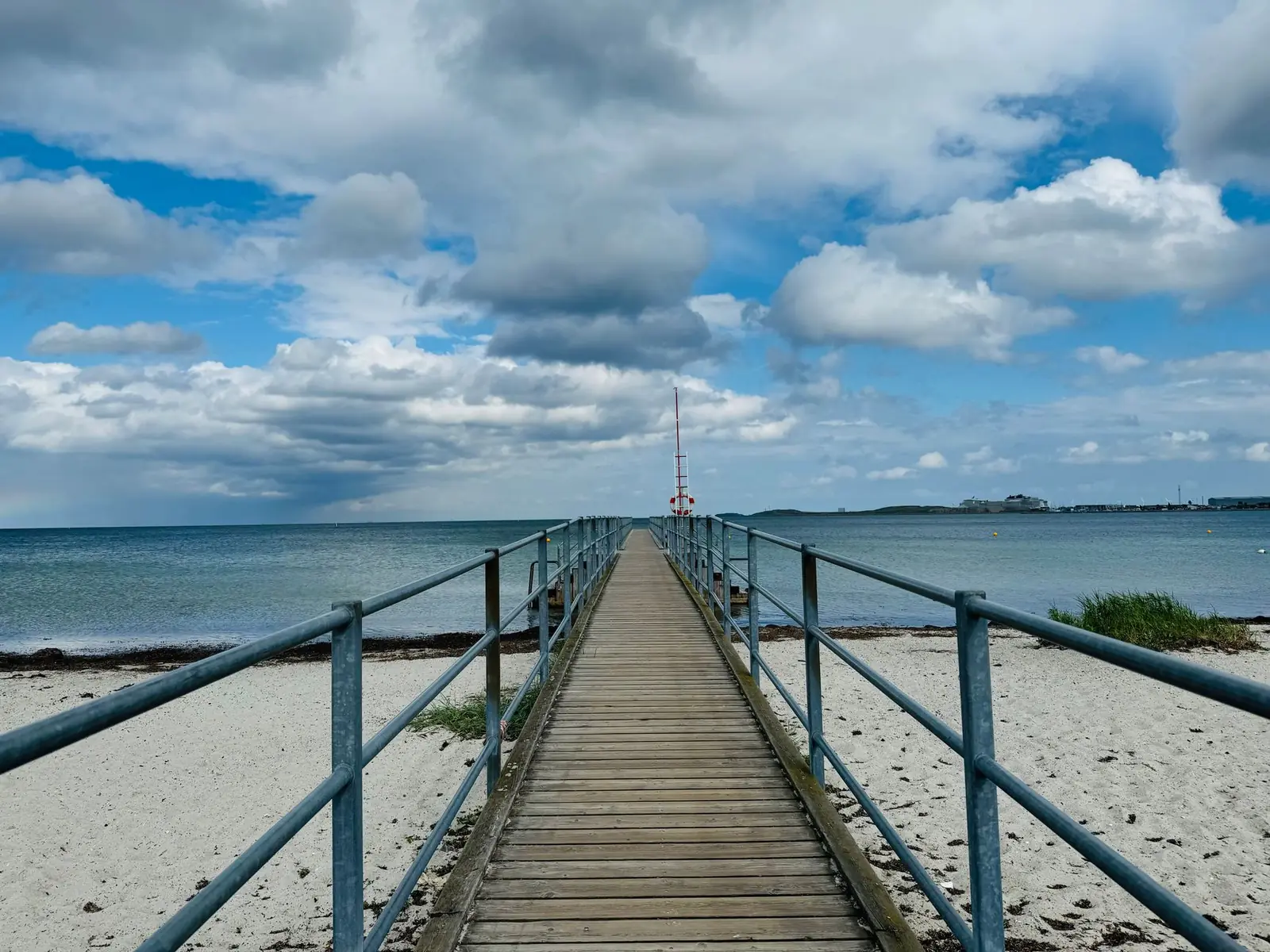
A little further up the coast, the small sandy beach at Charlottenlund sits beside the grassy ramparts of Charlottenlund Fort, an old coastal battery that now has a campsite and a restaurant. It is a pleasant, low-key spot with a bathing pier and lawns behind, about fifteen to twenty minutes’ walk from Charlottenlund station, and it suits anyone cycling the coast road towards Klampenborg.
Verdict: a nice stop on a coastal bike ride, but not worth a special trip when Bellevue is three stops further on.
Morning Beach or Evening Beach? The Compass Matters
Here is the thing no beach list mentions. Every beach on the Danish side of the Øresund, including Amager, Bellevue, Svanemølle, Charlottenlund and Kastrup, faces east. They are glorious in the morning and around midday, with the sun on the water. By late afternoon the sun has swung round behind you, over the city, and by early evening the sand is in shade at the beaches backed by trees and buildings, particularly Bellevue.
So plan by the clock. For a morning or a lunchtime swim, the Øresund beaches are perfect. For an evening by the sea, go where the sea is to the west or north: Ribersborg in Malmö, which faces west towards Copenhagen, or the north coast at Tisvildeleje and Hornbæk, where on a summer evening the sun goes down over the water.
Water, Jellyfish and Flags
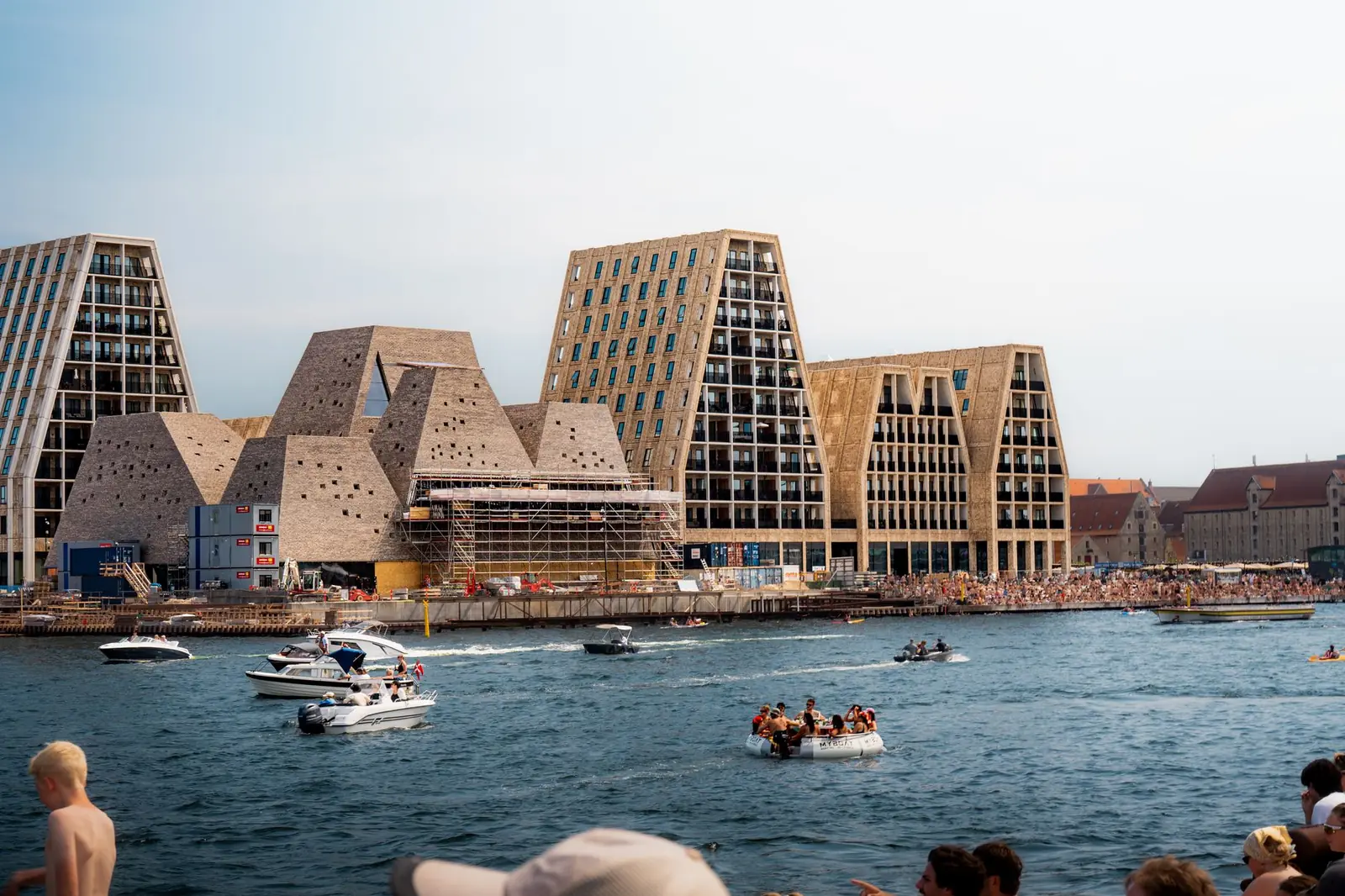
The water around Copenhagen is clean enough to swim almost everywhere, and many beaches fly the Blue Flag, the international mark for clean water and safety equipment; Denmark had 143 Blue Flag beaches in 2026. The sea is chilly in June and warmest in August, typically in the high teens Celsius, a little warmer in shallow lagoons and bays and a little fresher on the open north coast.
Three things to watch for. In late summer, jellyfish arrive: the common moon jellyfish is harmless, but the reddish lion’s mane, brandmænd in Danish, gives a painful sting, so look before you dive. In hot, still weather, algae blooms can occasionally make the water unsafe, and the local councils post warnings. And lifeguards are not posted at every beach, so check locally and watch children closely.
When to Go
The beach season runs from June to August, with September still swimmable on a warm day. Summer weekends are the busiest, especially at Amager Strandpark and Bellevue. Danish school holidays in high summer fill the north-coast villages, so go midweek if you can. Our guides to Copenhagen in summer and Copenhagen in August have the wider calendar.
Honourable Mentions
- Dragør, the old fishing village at the southern tip of Amager, has small beaches and a historic harbour, and makes a lovely afternoon by bike or bus.
- Rungsted, on the coastal railway north of Klampenborg, has a small beach near the Karen Blixen Museum.
- The coast road itself, Strandvejen, has bathing piers and small beaches all the way from Hellerup to Klampenborg, which makes it a very pleasant bike ride on a summer day. Our bike rental guide will get you on two wheels.
Frequently Asked Questions
What is the best beach near Copenhagen?
Amager Strandpark is the best all-round choice: 4.6 kilometres of sand, a shallow lagoon for children, and a short ride from the centre on the M2 metro. Bellevue in Klampenborg is the prettiest, and Tisvildeleje the best for a full day out.
Can you get to the beach by public transport from Copenhagen?
Yes. Amager Strandpark and Kastrup Søbad are on the M2 metro, Svanemøllestranden, Charlottenlund and Bellevue on the C-line S-train, Køge Bugt Strandpark on the A-line, and the north-coast beaches by train with a change at Hillerød or Helsingør.
Is the water clean at Copenhagen’s beaches?
Generally, yes. Many beaches fly the Blue Flag for water quality, and warnings are posted on the rare occasions when algae or pollution make swimming inadvisable.
How warm is the sea near Copenhagen?
Chilly in June and warmest in August, typically in the high teens Celsius. Shallow lagoons and bays warm up faster than the open sea.
Which beach near Copenhagen is best for children?
Amager Strandpark, for its shallow, sheltered lagoon, or Svanemøllestranden for a short visit close to the centre. Both are easy to reach by public transport.
Are there jellyfish near Copenhagen?
Yes, mostly in late summer. Moon jellyfish are harmless; the reddish lion’s mane can sting, so keep an eye out.
Where can I watch the sunset from a beach near Copenhagen?
The Danish beaches on the Øresund face east, so the sun sets behind them. For a sunset over the water, go to Ribersborg in Malmö or to the north coast at Tisvildeleje or Hornbæk.
Related Reading
- Outdoor Copenhagen for the parks, saunas and green escapes beyond the beaches.
- Day trips from Copenhagen to pair a beach with a castle, a museum or a cliff.
- Copenhagen with kids with the beaches and parks that work best for families.
- Louisiana Museum of Modern Art on the coast north of Copenhagen, with a sculpture garden down to the sea.
Photo Credits
- Arne Jacobsen’s blue-and-white striped lifeguard tower on a wooden pier at Bellevue beach, Klampenborg: photo by seier+seier, Life guard tower, Klampenborg.jpg, CC BY 2.0
- Bellevue beach at Klampenborg packed with sunbathers on a hot summer day, with lifeguard towers and yachts offshore: photo by Guillaume Baviere from Copenhagen, Denmark, Bellevue Beach (14767204124).jpg, CC BY-SA 2.0
- A huge crowd on Bellevue beach in the summer of 1944, watching costumed performers on the lawn: photo by Nationalmuseet – National Museum of Denmark from Denmark, Bellevue strand, Klampenborg, sommeren 1944 (7392604632).jpg, CC BY-SA 2.0
Final Thoughts
Copenhagen’s beaches are not tropical, and they do not pretend to be. What they offer instead is ease: a swim in clean sea water within a quarter of an hour of the city centre, a design-classic lifeguard tower, or a whole day at a thatched seaside village with a forest behind it.
Choose by the time of day as much as by the beach. Go east-facing in the morning, west or north in the evening, and bring a towel wherever you are staying. In a Danish summer, the sea is never far away.
Last verified: October 2026. Train times are typical journey times including connections; check the current timetable for the local lines to Tisvildeleje and Hornbæk, which run less often than city trains.