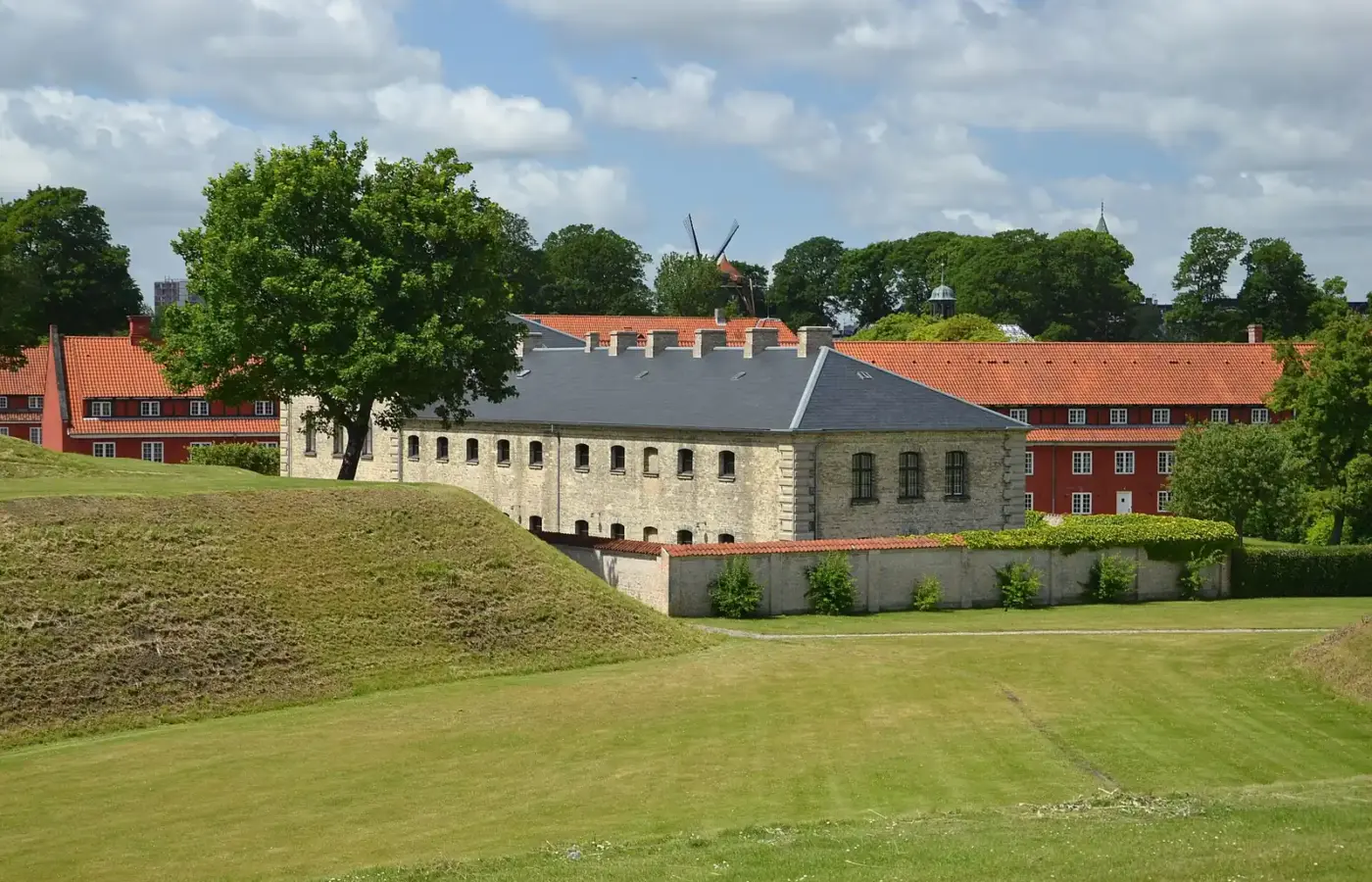
Most visitors see Kastellet from the wrong side. They walk past its moat on the way to the Little Mermaid, take their photograph of the statue and turn back, without ever climbing the grass bank beside them. On top of that bank is a tree-lined path round five bastions and two moats, with a windmill, a baroque church and rows of red barracks below, and soldiers still going about their business inside. It is free, it is open from six in the morning, and it makes Kastellet Copenhagen’s best short walk.
This guide covers what Kastellet is and why it is still a military base, a simple route round the ramparts, what to look for inside, when to go, the rules that come with walking through an active defence site, and how to fit it into a morning with the Little Mermaid and Amalienborg. Details were checked in October 2026.
Kastellet at a Glance
| Detail | |
|---|---|
| What it is | A five-pointed star fortress, built 1662–65 on the site of an earlier fort from 1626 |
| Entry | Free |
| Gates open | Daily from 06:00; until 20:00 in the winter half-year, 22:00 in the summer half-year |
| Still used by | The Ministry of Defence and several branches of the armed forces |
| Gates | The King’s Gate to the south, towards the city; the Norway Gate to the north |
| Time to allow | About an hour for the ramparts and the buildings inside |
| Nearest station | Østerport (S-train and metro), about ten minutes’ walk |
| Next door | The Little Mermaid, the Gefion Fountain and St Alban’s Church |
What Kastellet Is, and Why It Is Still Guarded
Kastellet, the Citadel, began as a smaller fort built for Christian IV in 1626, known as Sankt Annæ Skanse. What you walk today is its successor. After the Swedish siege of Copenhagen in 1658–60 had shown how exposed the city was from the sea, Frederik III had the fort rebuilt and enlarged between 1662 and 1665 to the plans of the Dutch military engineer Henrik Rüse. The first soldiers marched through its gates on 28 October 1664, and three of the old fort’s bastions were kept and folded into the new design.
The result is a textbook star fortress: five bastions, named for the King, the Queen, the Prince, the Princess and the Count, ringed by double moats. The shape is not decoration. Every angled bastion lets defenders fire along the face of its neighbours, so there is no stretch of wall an attacker can reach without being shot at from the side. Seen from the air it is one of the best-preserved fortifications of its kind in northern Europe.
On 9 April 1940, German troops landed at the harbour nearby and took the Citadel without resistance, a quiet humiliation for a fortress built to stop exactly that. Today the Ministry of Defence and several military units, including the Home Guard and the Defence Intelligence Service, work inside it. That is why some buildings are fenced off, why you may see uniformed staff crossing the parade ground with coffee, and why the place feels less like a monument than a working site that happens to let the public walk on its walls.
How to Walk the Ramparts
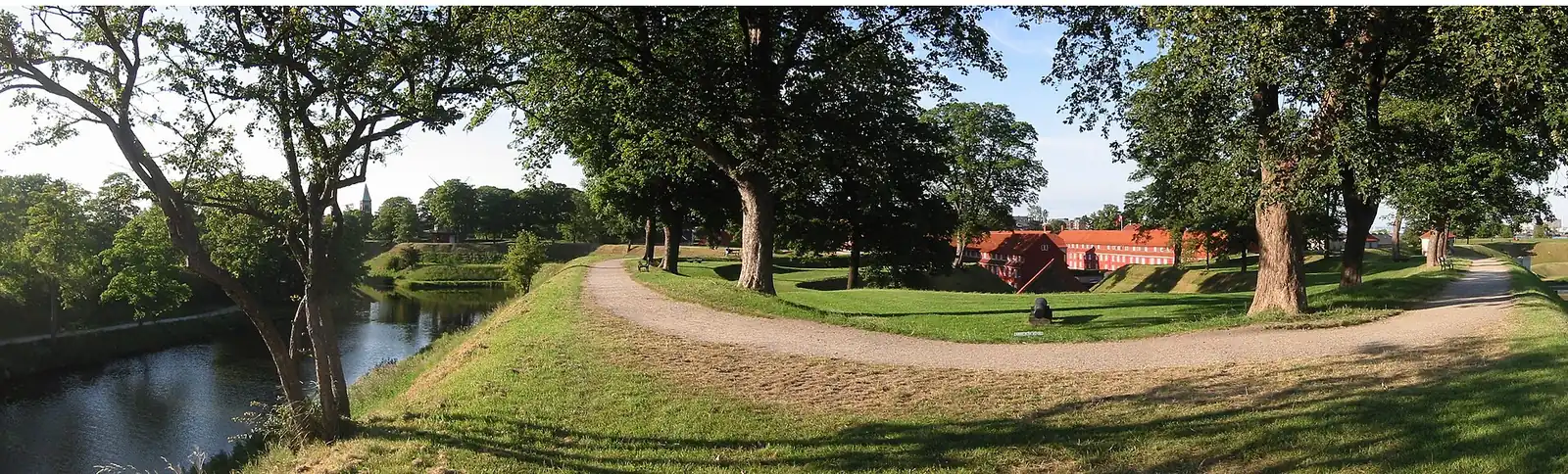
The simplest plan is to walk the top first and then drop inside. Come in through the King’s Gate from the south, crossing the moat from the park by St Alban’s Church, and take the first ramp or stairway you see up onto the ramparts. From there the path runs right round the star on top of the main wall, so you can choose either direction and simply keep going. At an easy pace the full circuit takes about half an hour, more if you stop at every bench, and you will want to.
The views change with each bastion. On the harbour side you look out over Langelinie, the masts of the marina and, in season, the cruise ships at the quays to the north. On the city side the tall spire of St Alban’s rises just beyond the moat. Inside the star, the red barracks rows and the church sit in their lawns like a model village. On the King’s Bastion stands the windmill, which is the obvious place to pause and the most photographed corner of the fortress.
Two practical notes. The path on top is a favourite running loop, so keep to one side and expect to be overtaken often in the early morning. And if you arrived by bike, leave it by the gate or push it: the rampart paths are narrow, busy with walkers, and not the place to ride. When you have finished the loop, come down inside to see the buildings up close, then leave by the Norway Gate to the north, either for Østerport station or along the moat towards the harbour and the Little Mermaid, a few minutes away.
What to Look For Inside
The church, and the prison behind it
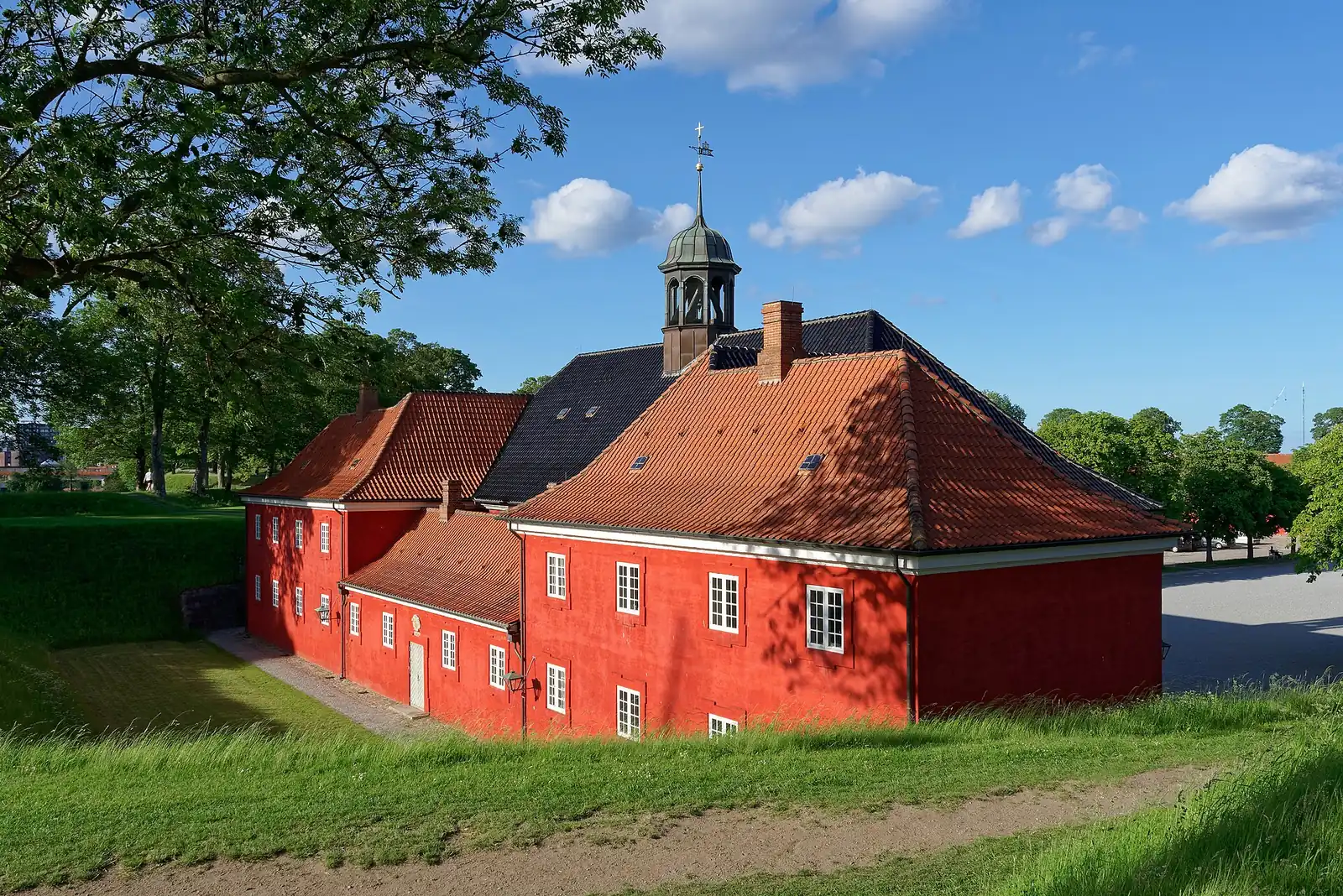
Kastelskirken, the Citadel Church, was built in 1703–04 in a heavy baroque style and is still in use as the Citadel’s church. The building attached to its back is the more remarkable half. It is the old prison, added in 1725, and the wall between the two had small holes cut through it so the prisoners in their cells could follow the services without ever being let into the church.
Its most famous inmate was Johann Friedrich Struensee, the German doctor who effectively ruled Denmark through the mentally ill Christian VII and had an affair with the queen, held here before his execution in 1772. Its most wretched was probably John Norcross, an English privateer who spent 32 years in Danish custody, sixteen of them in a wooden cage. The church is often locked outside services, but the outside of the prison block tells you most of what you need to know.
The windmill
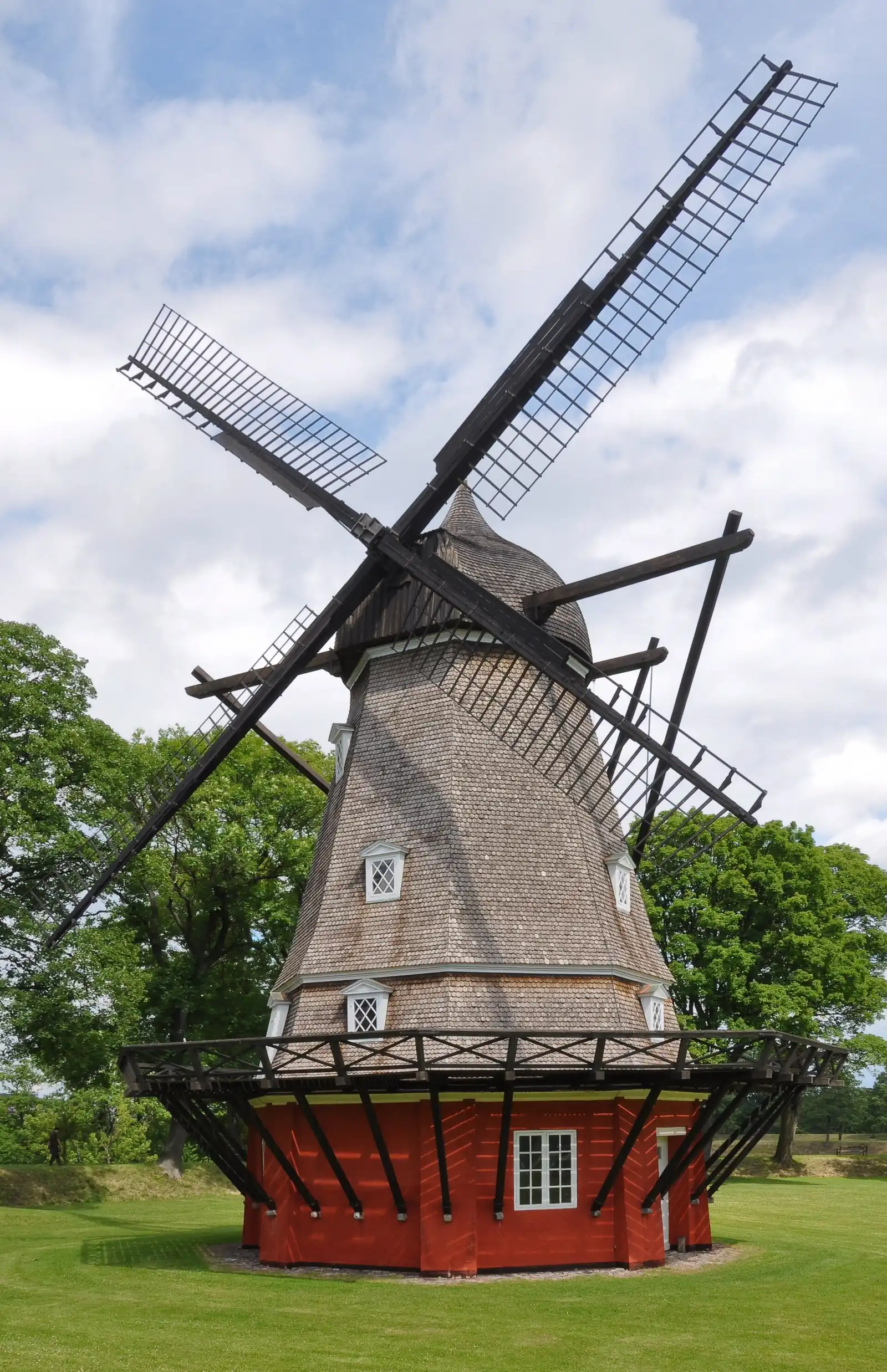
A windmill looks out of place on a fortress until you think about sieges. A garrison that could grind its own flour could hold out for longer, and Kastellet has had a mill on its walls for centuries. The current one, a Dutch-type mill with a shingled cap and a red base, was built in 1847 on the King’s Bastion to replace a post mill from 1718 that a storm destroyed. It is not open to visitors, but you can walk right up to it.
The Rows and the Commander’s House
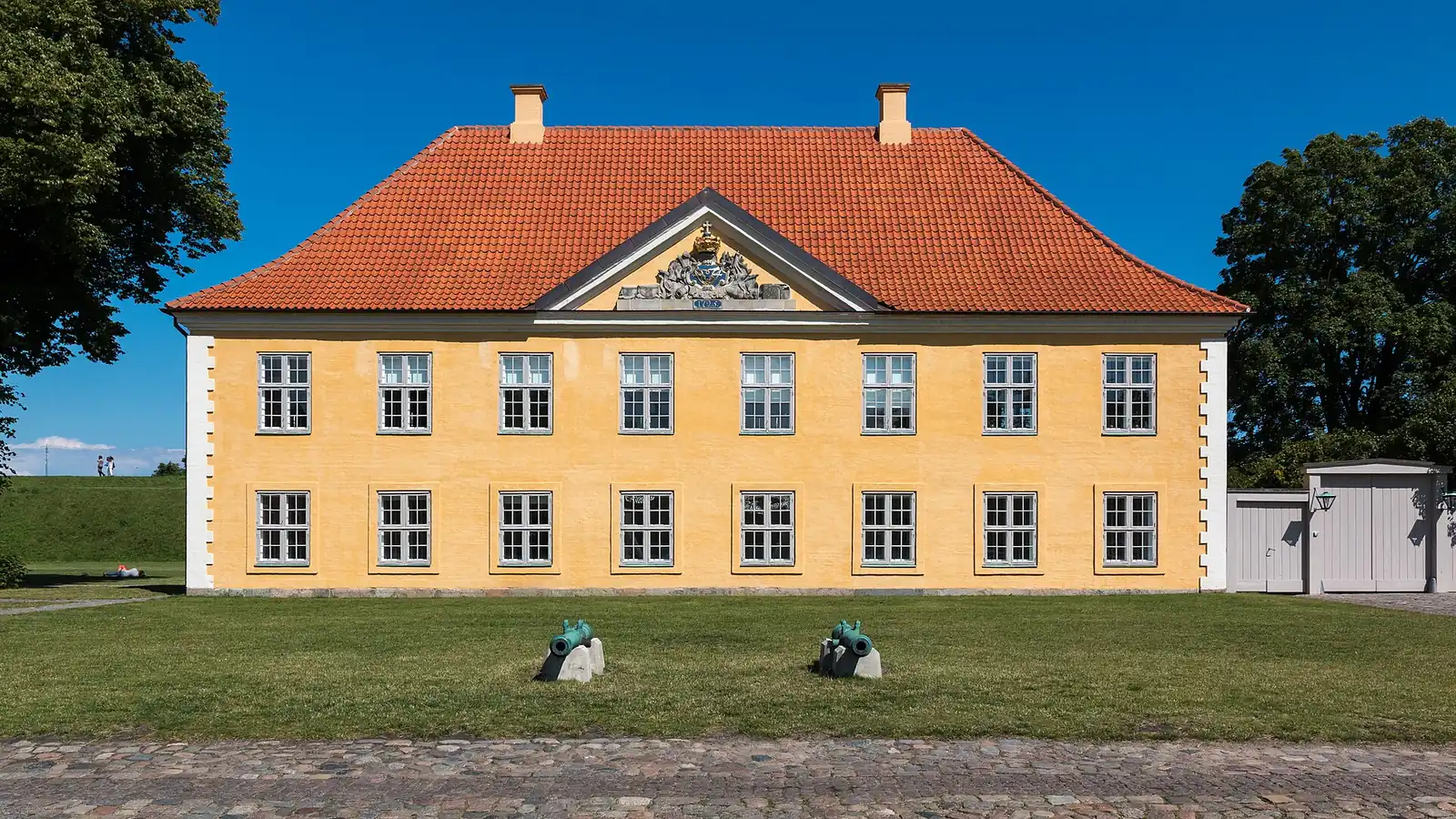
The long red barracks, known as Stokkene, the Rows, are six two-storey terraces laid out in Rüse’s original plan, with their mansard roofs added in 1768. They are still offices and quarters, so admire them from outside. Across the parade ground, the yellow Commander’s House was built in 1725 by the architect Elias Häuser, with a pair of old cannon on the lawn in front of it. Between them, the two gates are worth a look on your way in and out: both the King’s Gate and the Norway Gate date from 1663, the latter named for the kingdom that then shared Denmark’s crown.
When to Go

- Early morning is the best time. The gates open at 06:00, the light over the harbour is soft, and you will share the ramparts with runners and dog walkers rather than tour groups.
- Summer evenings are lovely, with people sitting out on the bastions until late. Remember the gates close at 22:00.
- Spring brings the cherry blossom along Langelinie, just outside the walls, usually in mid to late April; our Copenhagen in April guide has the timing.
- Culture Night, Kulturnatten, in October has in recent years seen the armed forces open buildings that are normally closed. If you are in town for it, check the programme.
The Rules: It Is Still a Military Area
Kastellet lets the public in on trust, and the rules are mostly common sense. Stay on the open paths and lawns, and respect any fences, barriers and signs, since parts of the site are working offices. Do not fly a drone, which is prohibited over military areas in Denmark. Keep dogs on a lead and pick up after them, and keep noise down near the buildings. Photography of the buildings and ramparts is normal; photographing personnel at work is best avoided. None of this is onerous, but it explains why Kastellet feels calmer than a public park.
Is Kastellet Worth It?
Yes, with the right expectations. Kastellet is not a museum: there are no exhibitions to buy a ticket for, most of the buildings are closed, and you will not learn its history from boards on every corner. What you get is an hour on one of the best-preserved star fortresses in Europe, a beautiful walk with harbour views, and a strong sense of the city’s military past, all for nothing.
The honest comparison is with its famous neighbour. The Little Mermaid is small, crowded and over in ten minutes; Kastellet is the better half of the trip. If you have an hour in the area, give the statue ten minutes and the ramparts fifty. It is also one of the best entries on our list of free things to do in Copenhagen, and a natural stop on any outdoor day in Copenhagen.
Getting There and What to Combine It With
From Østerport station, on the S-train and the metro, it is about ten minutes on foot to the Norway Gate. Our metro guide covers the lines.
The better approach is on foot from the south, which turns Kastellet into the end of one of the best walks in the city. Start at Nyhavn, head north along the harbour to Amalienborg, detour up Bredgade if you have time for the Marble Church or Designmuseum Danmark, then continue past the Gefion Fountain and St Alban’s Church to the King’s Gate. Walk the ramparts, leave by the Norway Gate for the Little Mermaid, and either return along the harbour or head inland to Østerport. It is about two kilometres end to end and fills a morning nicely; our one-day itinerary shows how it fits around the rest of the city, and our Østerbro guide covers the neighbourhood beyond the walls.
Frequently Asked Questions
Is Kastellet free?
Yes. There is no charge to enter Kastellet or walk its ramparts.
What are Kastellet’s opening hours?
The gates open daily at 06:00 and close at 20:00 in the winter half-year and 22:00 in the summer half-year. Individual buildings are not generally open to the public.
How long does it take to walk around Kastellet?
About half an hour for a loop of the ramparts at an easy pace, and an hour if you also explore the buildings inside and stop for the views.
Is Kastellet still a military base?
Yes. The Ministry of Defence and several military units work inside it, so some areas are closed and visitors are asked to respect signs and barriers. The ramparts and most open spaces are public.
Can you go inside the buildings at Kastellet?
Mostly not. The barracks, the Commander’s House and the windmill are not open to visitors, and the church is usually locked outside services.
How far is Kastellet from the Little Mermaid?
A few minutes on foot. The statue sits on the harbour just beyond the north-east corner of the fortress, so the two are easily combined.
Why is Kastellet shaped like a star?
The pointed bastions let defenders cover the walls of the neighbouring bastions with crossfire, leaving no blind spot for an attacker. It was the standard design for European fortresses in the 1600s.
Kastellet lies a short walk from the cruise quays at Langelinie and Nordre Toldbod. Our Copenhagen cruise port guide sets out a walking route from the quays past the ramparts to Amalienborg and Nyhavn.
Related Reading
- Christianshavn for the city’s other surviving ramparts, on the far side of the harbour.
- Copenhagen walking tours if you would like a guide to bring the military history to life.
- The National Museum of Denmark for the wider story of the wars that shaped the city.
- Copenhagen with kids because ramparts are made for running down.
Photo Credits
- Inside Kastellet: grassy ramparts, red barracks rows and the windmill rising beyond the trees: photo by Pudelek, Kastellet, Copenhagen (by Pudelek).JPG, CC BY-SA 4.0
- The gravel path along the top of Kastellet’s ramparts, curving round a bastion above the moat: photo by Niels Elgaard Larsen, Kastellet cph.jpg, CC BY-SA 3.0
- Kastellet’s Dutch-style windmill from 1847, with a shingled cap and red base, standing on the King’s Bastion: photo by Bob Collowan, Windmill of Kastellet (Copenhagen).jpg, CC BY-SA 3.0
- The red prison building attached to the back of Kastellet’s church, with the church’s copper bell turret above: photo by Jakub Hałun, Kastellet Prison, Copenhagen, 20220616 1846 6569.jpg, CC BY-SA 4.0
- The yellow Commander’s House at Kastellet, with two old cannon on the lawn in front: photo by Dietmar Rabich, Kopenhagen (DK), Kastell von Kopenhagen, Kommandantgården — 2017 — 1594.jpg, CC BY-SA 4.0
Final Thoughts
Kastellet is the kind of place that gets five minutes in most itineraries and deserves an hour. Its history is real and still in use, its walls are a pleasure to walk, and it costs nothing at all, which in Copenhagen is not a small thing.
Go early, walk the whole star, sit for a while by the windmill, and leave the Little Mermaid for last. She will still be there, and by then the crowds might have thinned.
Last verified: October 2026. Kastellet is still a working military site, so check the Danish armed forces’ website for current opening hours and closures before you go.