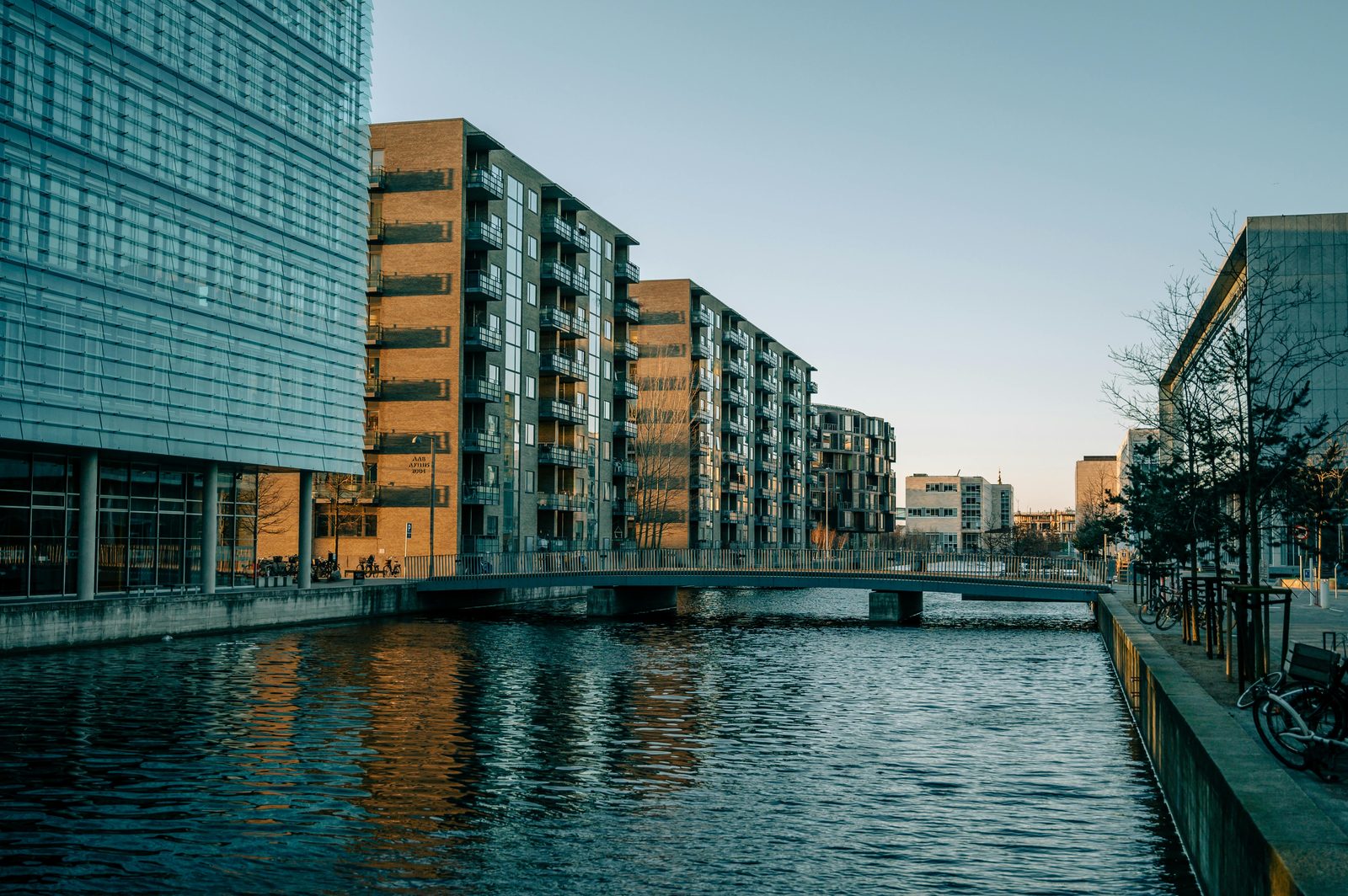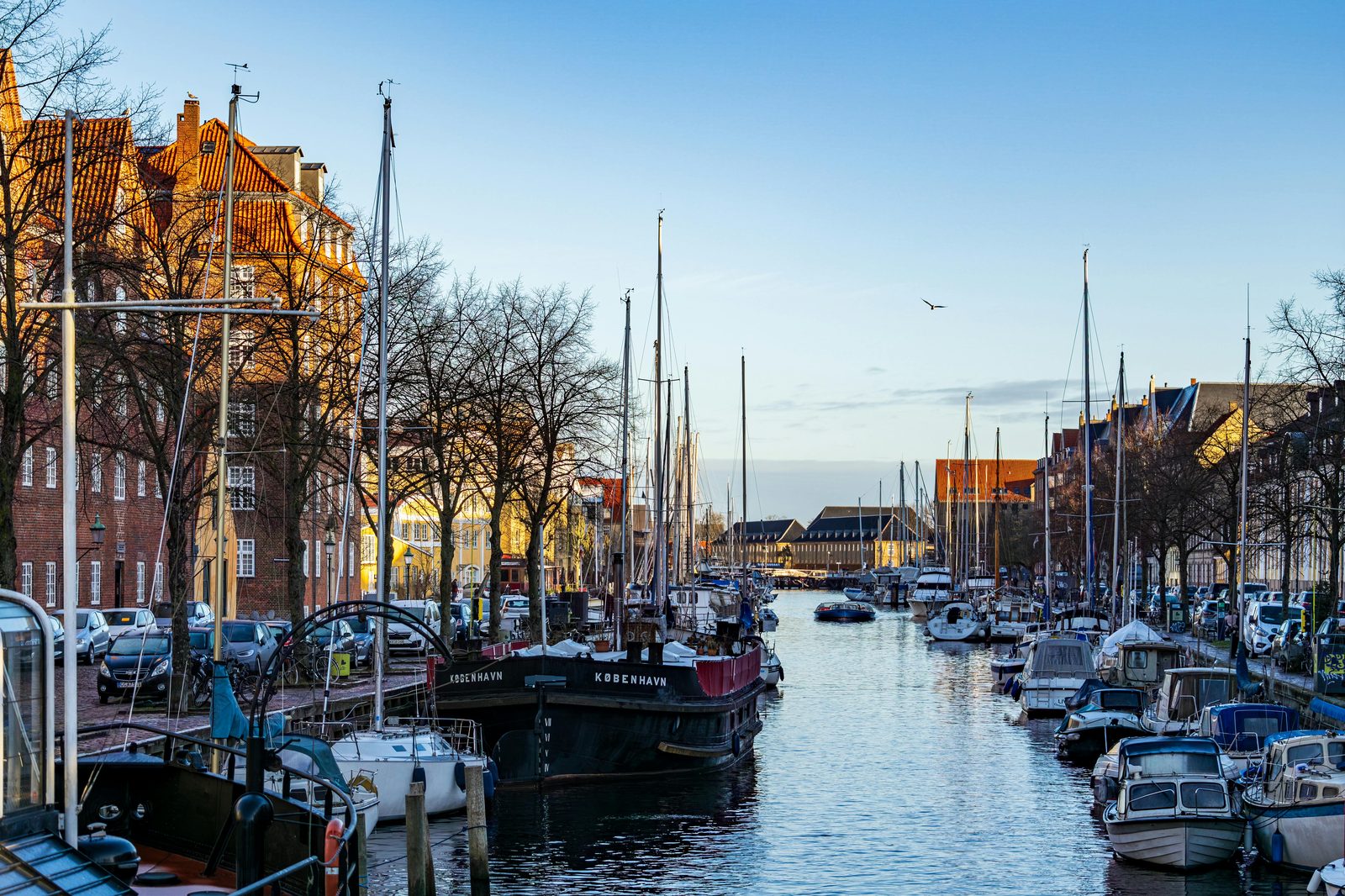
Cross one short bridge from Nyhavn and the mood changes completely. Christianshavn is Copenhagen’s canal district — a little grid of Dutch-style waterways that King Christian IV laid out in 1617, still lined with brick merchant houses, wooden barges and houseboats four centuries later. It’s the most atmospheric corner of the city and, oddly, one of the quietest: home to the twisting spire of Vor Frelsers Kirke, the self-governing enclave of Freetown Christiania, and — just across the water — Refshaleøen. If you want canals, calm and a strong sense of history, Christianshavn is where you’ll spend your favourite morning in Copenhagen.
Most people visit for the day rather than sleep here, and that’s the right approach — there’s not much lodging. This Christianshavn Copenhagen guide covers the canal walk, climbing the spire, visiting Christiania respectfully, where to eat, and how to plan the day. It’s one stop on our wider full guide to Copenhagen’s neighbourhoods tour.
Christianshavn at a glance
| Fact | Detail |
|---|---|
| Meaning | Christianshavn means ‘Christian’s harbour’ — founded 1617 by Christian IV |
| Population | ~10,500 residents (Christianshavn proper) plus around 850 in Christiania |
| Area | 1.0 km² (Christianshavn proper) |
| Defining sights | Vor Frelsers Kirke spire, Christiania, canals, houseboats, Refshaleøen nearby |
| Best for | Canal walks, alternative culture, fine dining, photography |
| Best metro | Christianshavn Station (M1, M2) |
| Atmosphere | Atmospheric, alternative, historic, peaceful, photogenic |
| History | Designed by Christian IV; modelled on Amsterdam; Christiania since 1971 |
| Best season | May–September for canal cafés; year-round for indoor culture |
Top things to do in Christianshavn
1. Climb the Vor Frelsers Kirke spire
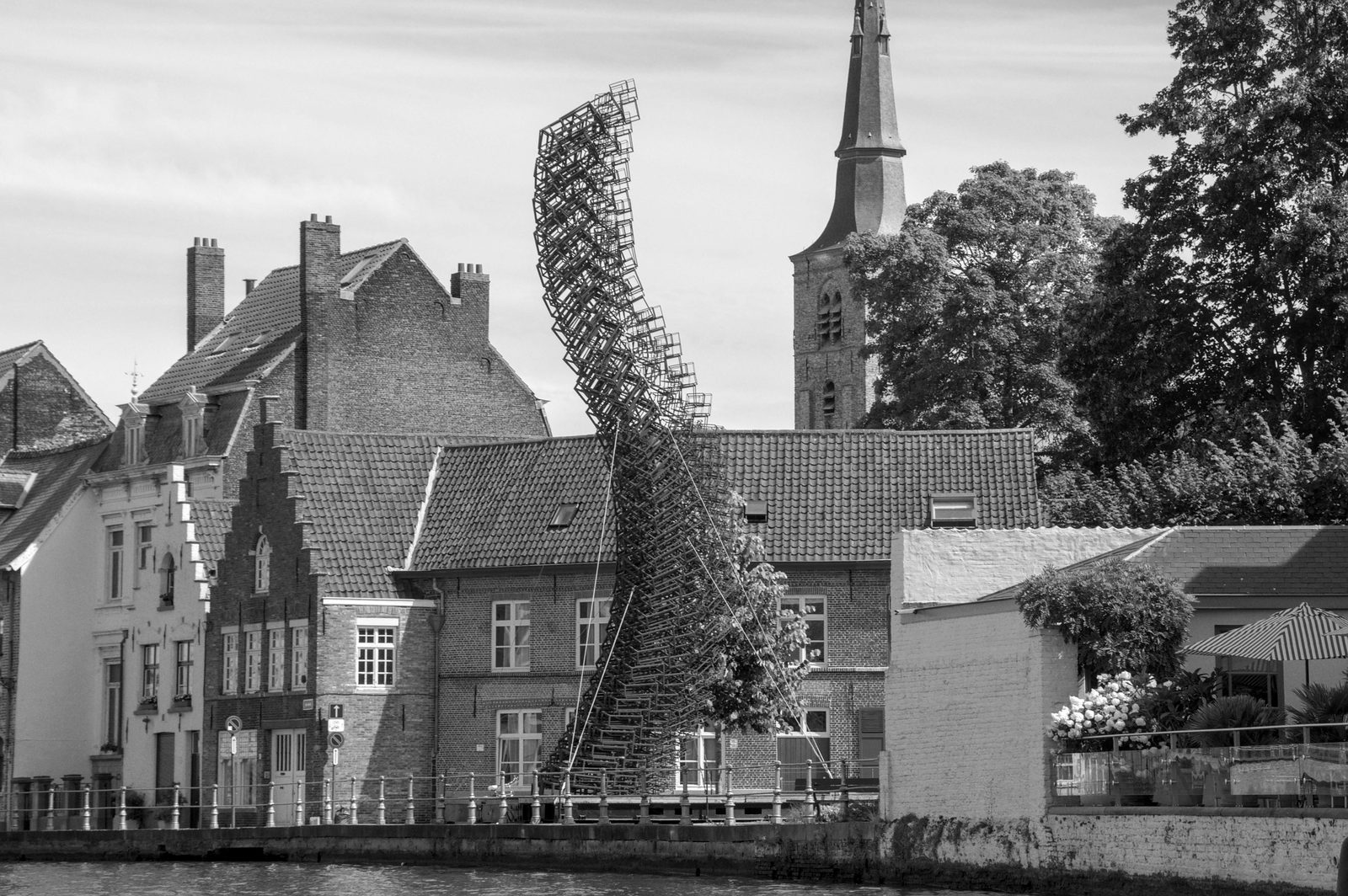
Vor Frelsers Kirke (the Church of Our Saviour) has the most distinctive spire in Copenhagen — 90 metres tall, with the final stretch spiralling up the outside of the tower. Climb all 400 steps and you’re rewarded with the best panoramic view in the city, out over the harbour and the canals. It’s 70 DKK, open until 20:00, and it’s free with the Copenhagen Card. Fair warning: the narrowest top section is genuinely vertigo-inducing.
2. Walk the canals

Christianshavn Kanal, the main canal, is the most photogenic stretch of water in Copenhagen — Dutch Renaissance houses, working boats, more than 200 permanent houseboats, and walking promenades down both sides. Give it an hour or two, and don’t skip the quieter side canals around Wilders Plads and Strandgade.
The district also contains Freetown Christiania, which has changed a great deal since 2024 and is worth reading up on before you wander in.
3. Visit Freetown Christiania

Freetown Christiania is the self-governing community founded by squatters in 1971 — around 850 residents living in former military barracks. Wander the colourful homemade houses, the lakeside paths, the workshop where the famous Christiania cargo bikes are built, and a handful of cafés and restaurants. Entry is free and resident-led tours run (around 175 DKK). One firm rule: no photography on Pusher Street, and ask before photographing people anywhere. Our things to do in Copenhagen guide has more on the etiquette.
4. See the houseboats

The houseboats are one of the district’s real quirks — a permanent floating community of 200-plus homes that’s been here since the 1970s. They’re not tourist attractions but people’s actual houses (a few appear on Airbnb), so admire them from the promenade. It’s the most distinctive way of living in the city.
5. Eat on Refshaleøen

Noma sits just across the harbour on Refshaleøen, and it’s the famed former restaurant of Copenhagen — three Michelin stars and repeatedly ranked the world’s best, before regular dinner service ended in 2024. Our Noma guide has the background. Nearby you’ll also find the Reffen street food market, the one-star Alouette, and Lille Bakery.
6. Cross Inderhavnsbroen

Inderhavnsbroen is the pedestrian-and-bike bridge linking Christianshavn to Nyhavn. It opened in 2016 after years of delays (locals nicknamed it a few unprintable things in the meantime) and now puts the old town just five minutes’ walk away. It’s a neat bit of modern engineering — the two halves slide apart sideways to let boats through — designed by Cuno Brullmann and Studio Bednarski.
7. Visit the Opera House

The Copenhagen Opera House (Operaen) sits on Holmen, the island just north of here — a 10-minute walk or a hop on harbour bus 991/992. Henning Larsen designed it and it opened in 2005; tickets run 350–1,250 DKK and daytime tours are around 110 DKK, Tuesday to Saturday. Our Holmen guide has the full picture of the island.
8. Sit canal-side at a café

In summer the district’s cafés spill right onto the water. A few favourites:
- Café Wilder (1947) — a historic Christianshavn institution; 75–145 DKK.
- Bastard Café — board games and drinks; 65–145 DKK.
- Café Det Nye Café — a modern Nordic room.
- Lagkagehuset Christianshavn — the flagship of the bakery that started here.
- Reffen (across on Refshaleøen) — the open-air street food market, April to October.
Architecture and history

Christian IV laid out Christianshavn in 1617 to expand Copenhagen south of the harbour, and he borrowed the blueprint straight from Amsterdam: a rectangular grid of canals, Dutch Renaissance brick houses, and a working harbour woven through the middle. A lot of the original 17th-century fabric survives. Asiatisk Plads (Asian Square) was once the headquarters of the Danish East India Company, and the trading company’s old garden became the Royal Library Garden. The Dutch influence is still everywhere you look.
Who Christianshavn suits
This is the district for couples, photographers and slow travelers — anyone who’d rather drift along a canal with a coffee than chase a checklist. It’s also a lovely, low-key base if you can find lodging, since you’re a short bridge from the old town but a world away from its bustle. Families do well here too: the canal walks are easy, and Christiania is more curious playground than anything to worry about.
It suits you less if nightlife is the point — evenings are quiet, and the action is over in Vesterbro. Hotel choice is genuinely limited, so if you need a wide range of rooms, base yourself in Indre By and visit by Metro. And if you’re chasing the classic museums and palaces, they’re across the water in the old town.
Where to eat in Christianshavn
From a one-star tasting menu to a bistro that’s been going since the 1940s, the district punches above its size. Prices are rough guides — check before you book.
Fine dining
- Alouette — modern Nordic in a former bakery (Refshaleøen); one star; around 1,250 DKK.
- Era Ora — refined Italian, going since 1983; tasting around 1,200 DKK.
- 108 — natural wine and Nordic small plates.
Casual
- Café Wilder — a Danish bistro since 1984.
- Reffen — the open-air street food market (April–October), 30-plus vendors.
- Sankt Annæ — traditional Danish smørrebrød.
- Restaurant Kanalen — relaxed, right on the canal.
- Christianshavn Bodega — a proper neighborhood bar.
Where to stay in Christianshavn
Lodging is thin on the ground here, which is part of the district’s charm — most visitors stay elsewhere and hop over on the Metro (M1/M2 to Christianshavn). If you do want to base yourself nearby:
- 71 Nyhavn Hotel (technically Nyhavn, across the bridge) — 2,500–5,000 DKK.
- Houseboat rentals — 1,500–3,500 DKK a night for the novelty of sleeping on the canal.
- Cabinn Vesterbro — five Metro stops away; 600–900 DKK.
Our where to stay for first-timers guide compares the neighborhoods if you’re weighing your options.
A half-day walking route
Christianshavn in about 3 hours
- Metro M1 or M2 to Christianshavn Station.
- Walk to Vor Frelsers Kirke and climb the spire (about 45 minutes).
- Follow Christianshavn Kanal south — the main canal walk.
- Spend an hour in Christiania (respectfully, no Pusher Street photos).
- Lunch canal-side at Café Wilder, or at Reffen in season.
- Cross Inderhavnsbroen to Nyhavn.
- Loop back past the Opera House and take the harbour bus.
- Finish with a drink at 108 or a board game at Bastard Café.
Practical tips
- Climb the spire early. It opens at 09:00 — fewer people, and the weather turns fast up top.
- Respect Christiania’s rules. No photography on Pusher Street; treat the homes as homes.
- Christiania winds down by 22:00 in its public areas.
- Book Café Wilder’s canal seats in summer.
- Reffen is seasonal — mid-March to the end of September, plus an autumn season in October.
- Bring a layer. The canal walks can be windy.
- Wear sturdy shoes for the spire — it’s steep and not for the vertigo-prone.
- Toilets are easiest at Café Wilder, Reffen and the church.
- Pair it with Refshaleøen — the two make a full, satisfying day.
Christianshavn FAQs
Is Christianshavn safe?
Yes — it’s safe day and night, and even Christiania is fine for visitors who follow the rules (no Pusher Street photos, respect private homes). As everywhere in the city, pickpocketing is the only real concern.
What is Christianshavn known for?
Its 17th-century Dutch-style canals, laid out by Christian IV; the twisting spire of Vor Frelsers Kirke; the self-governing Freetown Christiania; the permanent houseboats; and Refshaleøen, just across the water.
Can I visit Christiania?
Yes — visitors are welcome and entry is free. Walk Pusher Street (no photos), see the colourful houses, and stop at a café or bakery. Photography rules vary by area, so ask if you’re unsure. Resident-led tours run for around 175 DKK.
How long should I spend in Christianshavn?
Half a day covers the highlights — the spire, Christiania, a canal walk and lunch. Make it a full day if you’re adding Refshaleøen next door for Reffen and the Opera House.
Where’s the spiral spire?
At Vor Frelsers Kirke, Sankt Annæ Gade 29. Entry is 70 DKK, it’s 400 steps to the top (the last 150 outside), and it’s open until 20:00, with last entry at 19:30. Free with the Copenhagen Card.
How do I get to Christianshavn?
Metro M1 or M2 to Christianshavn Station. From Indre By or Nyhavn, it’s a five-minute walk over Inderhavnsbroen. Harbour buses 991, 992 and 993 also stop here.
Is there parking in Christianshavn?
Only limited paid street parking (roughly 10–30 DKK an hour). Take the Metro instead — M1 and M2 reach the district directly from central Copenhagen and the airport.
Christianshavn or Indre By?
Most visitors stay in Indre By and visit Christianshavn by Metro, since lodging here is limited. A houseboat rental is a memorable exception; otherwise, day-trip it from an old-town or Vesterbro base.
The spire that defines the neighbourhood is also its best view, and the climb deserves a page of its own: 400 steps, the last 150 on the outside of the building, and a tower that shuts without notice whenever the copper treads get wet. Everything you need, from the 70-krone ticket to the best time of day to go, is in our guide to the Church of Our Saviour.
Related reading
- The Nørrebro district — Jægersborggade, Superkilen and the best bakeries in the city.
- The city’s elegant west side — the palace gardens, Copenhagen Zoo and a quieter, greener side of the city.
- Carlsberg City — the Elephant Gate, the brewery tastings and Copenhagen’s newest district.
- The old town — Strøget, the Round Tower and most of the postcard sights in one district.
- The Sydhavn harbour district — harbour swimming at Islands Brygge, GoBoat rentals, the Sluseholmen canals and the best sunsets.
- Nyhavn complete guide
- Copenhagen itinerary
- The Østerbro neighbourhood
Final thoughts
Christianshavn is the most atmospheric district in Copenhagen — 17th-century canals, that spiralling church spire, the free-wheeling world of Christiania, the houseboats, and Refshaleøen just across the water. Climb the spire for the view, wander the canals, visit Christiania with respect, eat canal-side at Café Wilder, and cross Inderhavnsbroen back to Nyhavn. Most people day-trip it from the old town, and it richly rewards a full, slow one. This is the Copenhagen the photographers came for.
Last updated: July 2026.