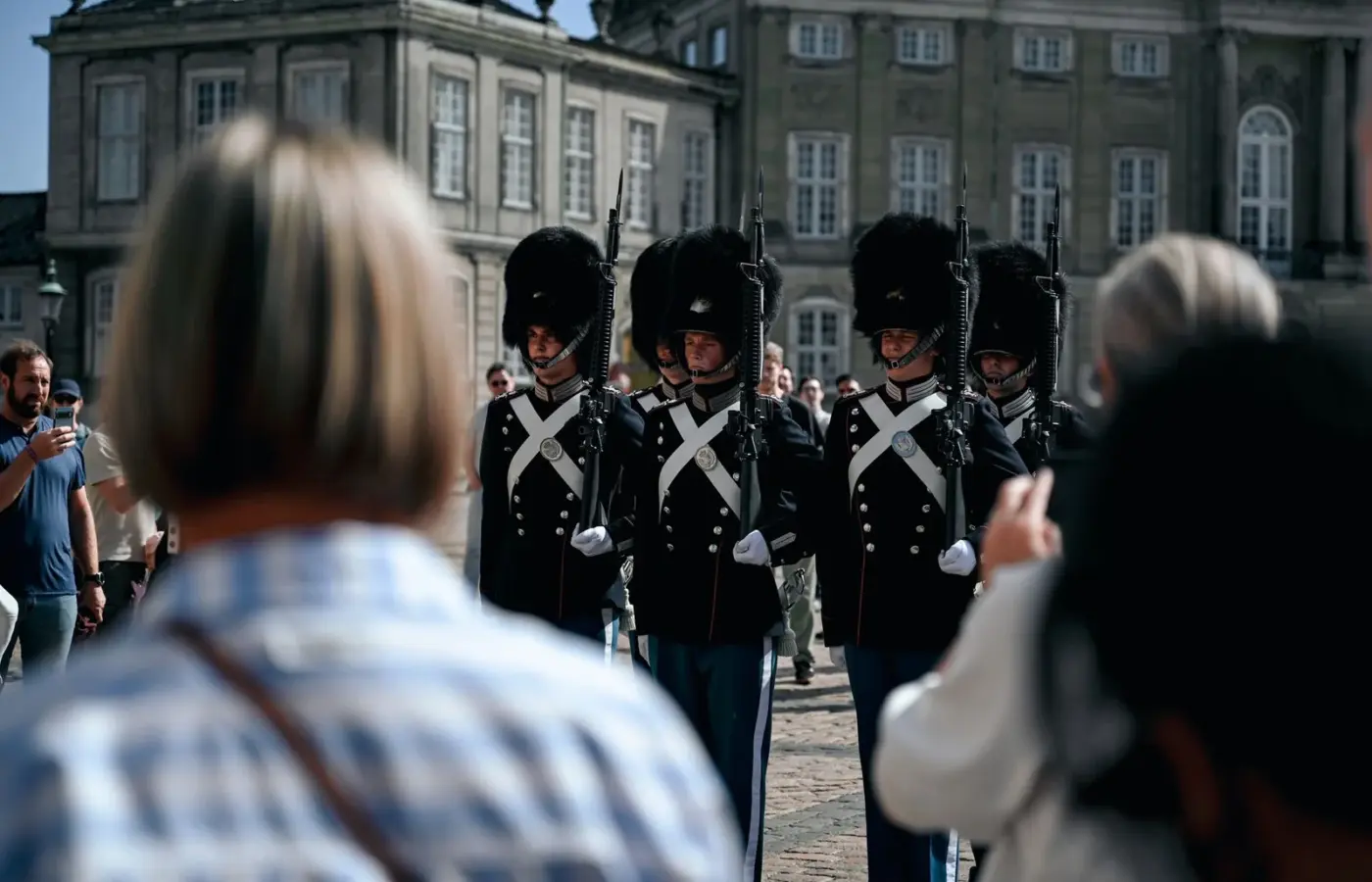
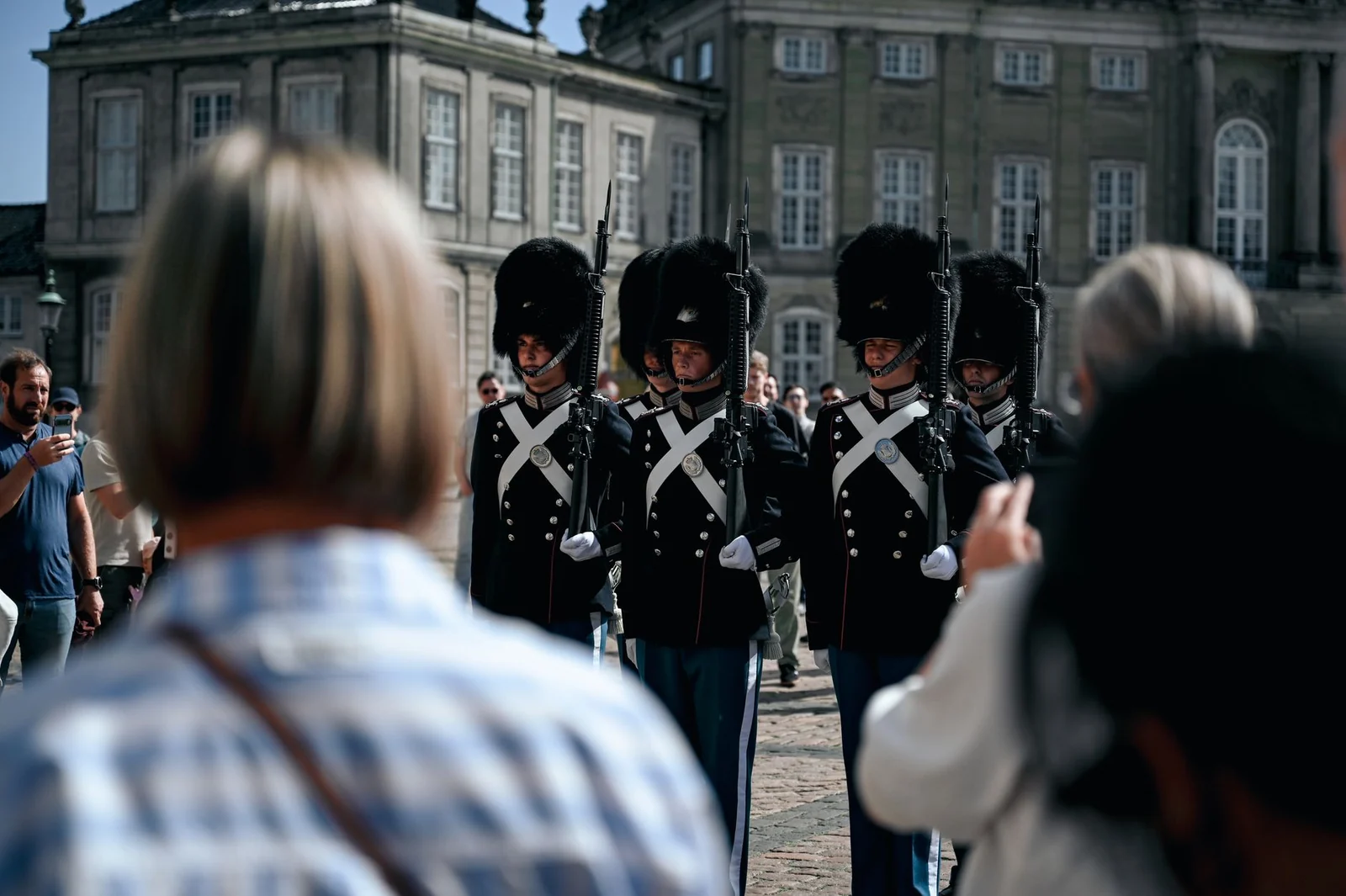
The Changing of the Guard happens at noon every day at Amalienborg, it is free, and it lasts about half an hour. The guards leave their barracks on Gothersgade at 11:27 and march through the city centre to get there, which is the better half of the spectacle and the half most visitors miss. The palace museum inside Christian VIII’s Palace costs 125 DKK online and takes about an hour.
It is one of the set pieces in our ranked guide to the city’s museums and landmarks.
Changing of the Guard: Times and Route
| Detail | Fact |
|---|---|
| Ceremony | 12:00 noon, daily, all year |
| Departure from barracks | 11:27 for the King’s Guard, a few minutes later for the lesser guards |
| Barracks address | Livgardens Kaserne, Gothersgade 100, next to Rosenborg |
| Whole window | Roughly 11:45 to 12:15 |
| Cost | Free |
| Best arrival time | On the square by 11:45, or on Købmagergade from 11:35 to watch the march |
The outbound route runs from the barracks along Rosenborggade, Købmagergade and Østergade, across Kongens Nytorv, then up Bredgade, through Sankt Annæ Plads and Amaliegade into the palace square. It passes the Round Tower and Kongens Nytorv on the way. Afterwards the outgoing guard returns past the Marble Church and along Store Kongensgade.
Here is the advice nobody gives you: do not stand on the square. From 11:35 you can watch the column march up Købmagergade or across Kongens Nytorv with a fraction of the crowd, and you get movement rather than a static formation. Then walk down behind them and you are on the square for the ceremony anyway.
If you miss noon entirely, the posts are relieved every two hours throughout the watch. It is a much smaller affair with no audience, and it is free.
There Are Three Different Guards, and Only One Is Worth Planning Around
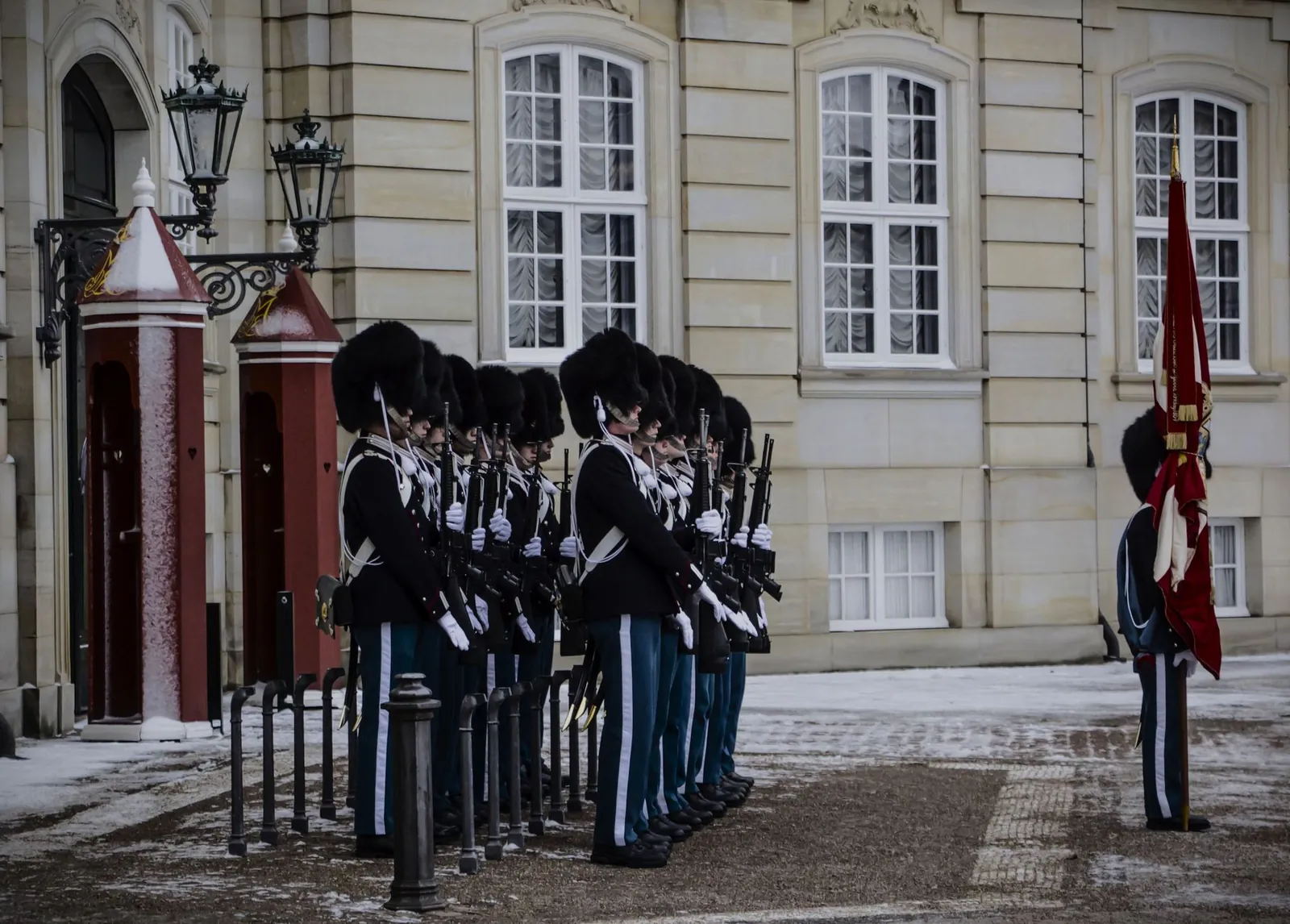
This is the fact that changes whether your visit is impressive or underwhelming, and almost no guide explains it.
| Guard | When | Commanded by | Band |
|---|---|---|---|
| Kongevagt (King’s Guard) | King Frederik X is in residence | A Major or Captain | Yes, the largest |
| Løjtnantsvagt (Lieutenant’s Guard) | The King is away but another senior royal is in residence as regent | A Captain or 1st Lieutenant | Yes |
| Palævagt (Palace Guard) | No royal in residence | A Sergeant | No band at all |
The ceremony happens daily regardless, but the Palace Guard version is a dozen or so soldiers and silence, while the King’s Guard brings a full musikkorps and the flag. You can tell which one you are getting on the square: the King’s Guard is the tier that carries the flag, handed over by the Adjutant to mark the transfer of command.
Now the counter-intuitive part. The royal family lives at Amalienborg in winter and at Fredensborg in summer, moving out to Fredensborg in early May. Which means summer visitors, who turn up in the largest numbers, are statistically most likely to get the Palace Guard with no band. Winter visitors get the good one. If the full ceremony matters to you, come between roughly October and April, and check kongehuset.dk before you go.
The Amalienborg Museum: Tickets and Hours
The museum occupies Christian VIII’s Palace, the north-west of the four, and you enter through the gate nearest Frederiksgade.
| Ticket | Online | At the door |
|---|---|---|
| Adult | 125 DKK | 135 DKK |
| Student | 80 DKK | 90 DKK |
| Under 18 | Free | Free |
| Groups of 10+ | 116 DKK per person | — |
Booking online saves 10 DKK a ticket. It is included free with the Copenhagen Card, in which case just go.
Opening hours, which change more than you would expect:
- 28 March to 1 November: daily 10:00–16:00
- 27 June to 30 August: daily 10:00–17:00, the summer extension
- 2 November to 23 December: Tuesday to Sunday 10:00–16:00, closed Mondays
- 24 and 25 December closed; 26 to 30 December 10:00–16:00; 31 December 10:00–14:00; 1 January 11:00–19:00
- Through the winter, Mondays are closed
The museum’s own site carries a standing warning to check the current week’s hours before visiting, which is unusual enough that we will repeat it here. Inside you get the private interiors of the last century and a half of Danish monarchs, with Christian IX and Queen Louise’s rooms preserved intact, the Gala Hall, the Garden Room and the Fabergé Chamber. Budget about an hour.
One warning worth more than any of the above: backpacks are not allowed in the museum and handbags are limited to 15 by 23 by 15 centimetres. The cloakroom is free, but if you have arrived with a daypack expecting to walk straight in, you will not. Photography is handheld only, no tripods or monopods.
The Royal Palace Pass: When It Pays
If Amalienborg is the only royal site you plan to see, buy a single ticket. If you are doing two or more, the Royal Palace Pass at 245 DKK online (255 at the door) covers Rosenborg Castle, the Amalienborg Museum and all the Christiansborg Palace visitor sites for 72 hours from your first visit. It includes the audio guides at all three, normally 35 DKK each, and 10 per cent off the gift shops.
Three separate adult tickets comfortably exceed 245 DKK, so the maths works. One booking rule matters: Rosenborg has a visitor cap and needs a timed slot, so you must start the pass there. Amalienborg and Christiansborg need no reservation.
If you already hold a Copenhagen Card, the pass is redundant. Our verdict on the Copenhagen Card goes through the break-even maths.
The Four Palaces and Who Lives in Them
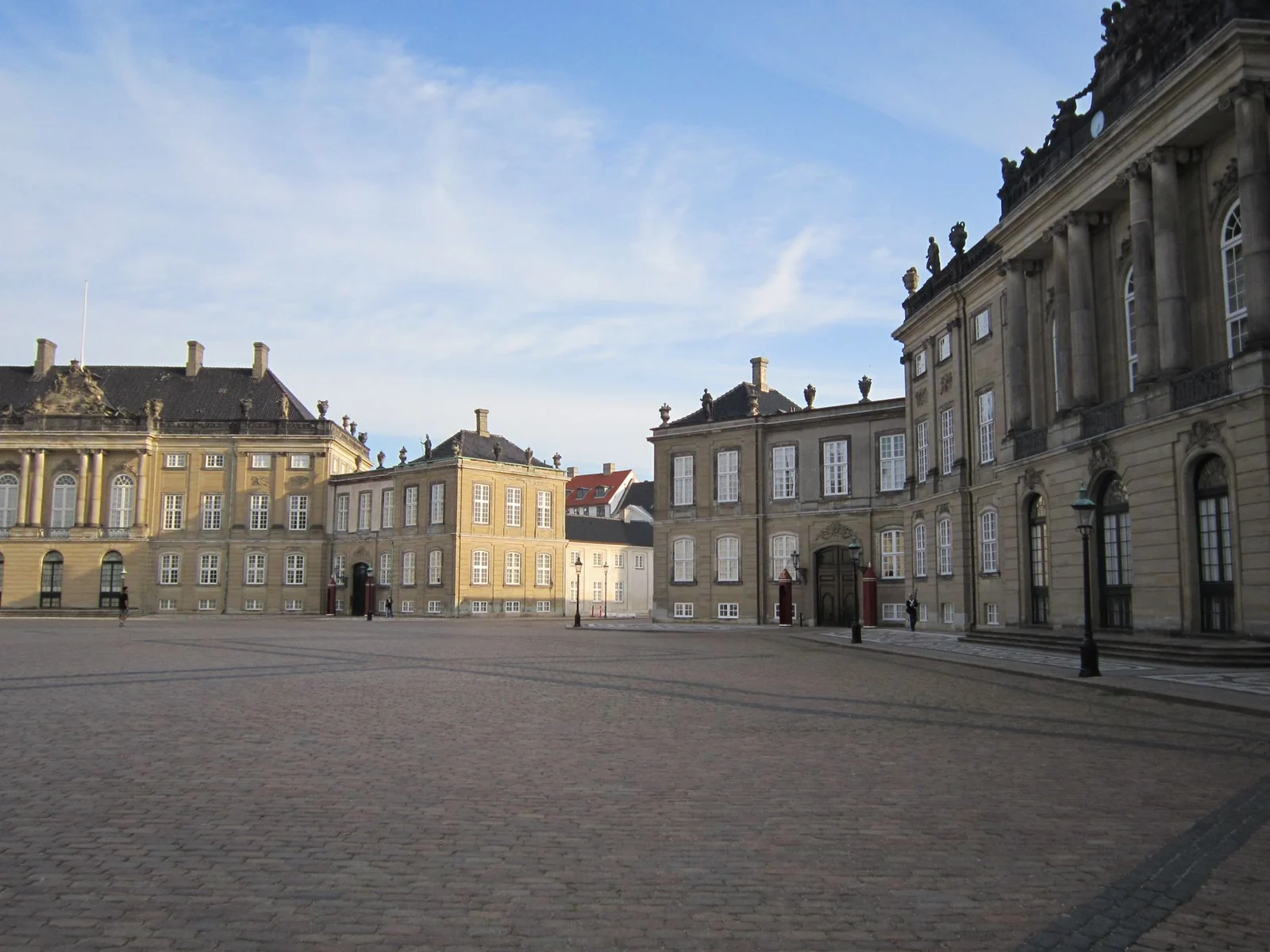
Four near-identical rococo palaces by Nicolai Eigtved around an octagonal square, joined by C. F. Harsdorff’s colonnade of 1794–95. The royal family only moved in that December, after the Christiansborg fire of 1794 left them homeless. It was meant to be temporary.
- Frederik VIII’s Palace, north-east. Home of King Frederik X, Queen Mary and their four children. Renovated in 2010.
- Christian IX’s Palace, south-east. Queen Margrethe II’s home since 1967, and her winter residence.
- Christian VII’s Palace, south-west. The King’s representative and guest palace, used for official ceremonies.
- Christian VIII’s Palace, north-west. The museum, and the official residence of Prince Joachim, Princess Marie and Princess Benedikte.
The Square, the Statue and the Best Photograph
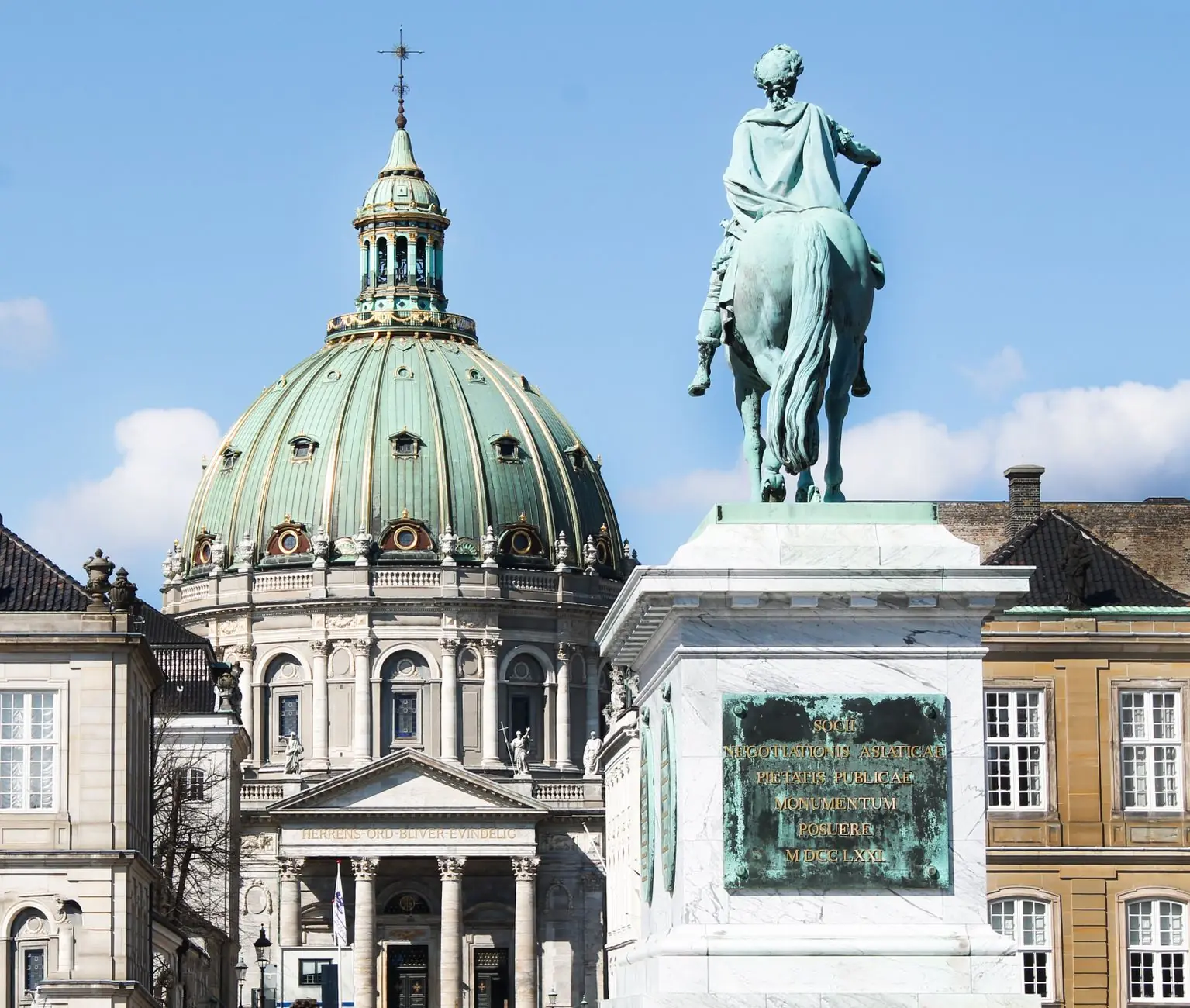
The equestrian statue in the middle is Frederik V by the French sculptor Jacques-François-Joseph Saly. It was begun in 1753, its foundation stone laid in 1760, and it was finally unveiled in 1771, five years after the king it commemorates had died. It was famously, ruinously expensive.
Stand at the statue and you are on the axis of Frederiksstaden, the planned quarter this square anchors. Look one way up Frederiksgade and the dome of the Marble Church closes the view. Look the other way across the harbour and the Opera House sits precisely opposite. That cross-axis is the whole reason the square is laid out as it is, and it is the photograph worth taking.
For the ceremony itself, stand on the Frederiksgade side so the Marble Church dome sits behind the guards. Stay inside the marked green areas, keep 1.5 metres clear of the palace buildings, and do not sit on the steps.
Getting There and What to Combine It With
The nearest Metro is Marmorkirken on the M3 Cityring, which comes out beside the church. Kongens Nytorv works too and is served by all four lines. On foot it is a short walk north along the harbour from Nyhavn, or up Bredgade or Sankt Annæ Plads from Kongens Nytorv. There is no parking, and vehicles cannot enter the square at all.
The best half-day here: start at Rosenborg when it opens, walk next door to the barracks on Gothersgade to catch the 11:27 departure, follow the guards down through the city, and arrive at Amalienborg for noon. Then the Marble Church, which is free and two minutes away, and the Designmuseum on Bredgade. That is a tight, walkable morning that no other guide sequences for you.
The square itself is open, free and step-free, though the cobbles are the real obstacle for anyone with mobility issues. Inside the museum, wheelchair users have access to every part via lifts, wheelchairs can be borrowed free with advance booking, and there is an accessible toilet in the basement.
Is the Museum Actually Worth It?
Honestly: 125 DKK for about an hour of preserved nineteenth-century royal apartments. Worth it if you like interiors, Fabergé or Danish royal history. Skippable if you only have one day in Copenhagen, in which case Rosenborg and the crown jewels is the stronger single choice, and Christiansborg’s reception rooms are the grander ones.
The square and the ceremony, on the other hand, cost nothing and are worth twenty minutes of anyone’s itinerary. Treat the museum as optional and the noon parade as the reason you came.
Frequently Asked Questions
What time is the changing of the guard at Amalienborg?
The ceremony is at 12:00 noon, every day of the year. The guards leave their barracks on Gothersgade at 11:27 and the whole thing is over by about 12:15.
Is the changing of the guard free?
Yes. The square is public and there is no ticket. Only the museum inside Christian VIII’s Palace charges.
How do you know if the King is home?
Look at the guard. The King’s Guard is the only tier that carries the flag and it brings the largest band. A dozen soldiers with no music means no royal is in residence. In practice the family is at Amalienborg in winter and at Fredensborg from around early May.
Can you go inside Amalienborg Palace?
One of the four. Christian VIII’s Palace houses the Amalienborg Museum, at 125 DKK online. The other three are private royal residences and are closed to visitors.
Is Amalienborg on the Copenhagen Card?
Yes, admission to the museum is included. Show the QR code at the museum shop.
Which palace does the Danish royal family live in?
King Frederik X and Queen Mary live in Frederik VIII’s Palace; Queen Margrethe II lives in Christian IX’s Palace. Both are on Amalienborg Square, and both are winter residences, with the family moving to Fredensborg for the summer.
Does the ceremony happen in the rain?
It runs daily year-round. Weather does not normally stop it, though a very small guard on a wet Tuesday in February is a modest spectacle.
Look west across the square from the guard change and the dome filling the view is the Marble Church, built on the same axis as the palaces. Entry is free, but the dome climb runs only twice a week for fifteen people at a time with no booking — our guide to the Marble Church explains how to get a place and how to fit it round the noon guard change.
Related Reading
- The Little Mermaid, ten minutes north sits at the far end of the same harbour walk through Kastellet.
- The Round Tower is on the guards’ own route and worth the detour on the way down.
- The wider list of what to see puts the palace in context with everything else in the centre.
- A single day in Copenhagen builds the noon ceremony into a workable route.
Final Thoughts
Amalienborg is one of the few free set pieces in Copenhagen that genuinely rewards planning. Turn up at noon with everyone else and you will see a formation over other people’s heads. Start at the barracks at 11:27, walk down with the column, and stand on the Frederiksgade side with the Marble Church behind, and it becomes something worth the morning. Come in winter and you will probably get the full guard with the band. Come in July and you will probably not, which is not what most people expect.
Last verified: September 2026 against denkongeligesamling.dk and kongehuset.dk. Note that the old kongernessamling.dk address now redirects; many guides still link the dead domain.