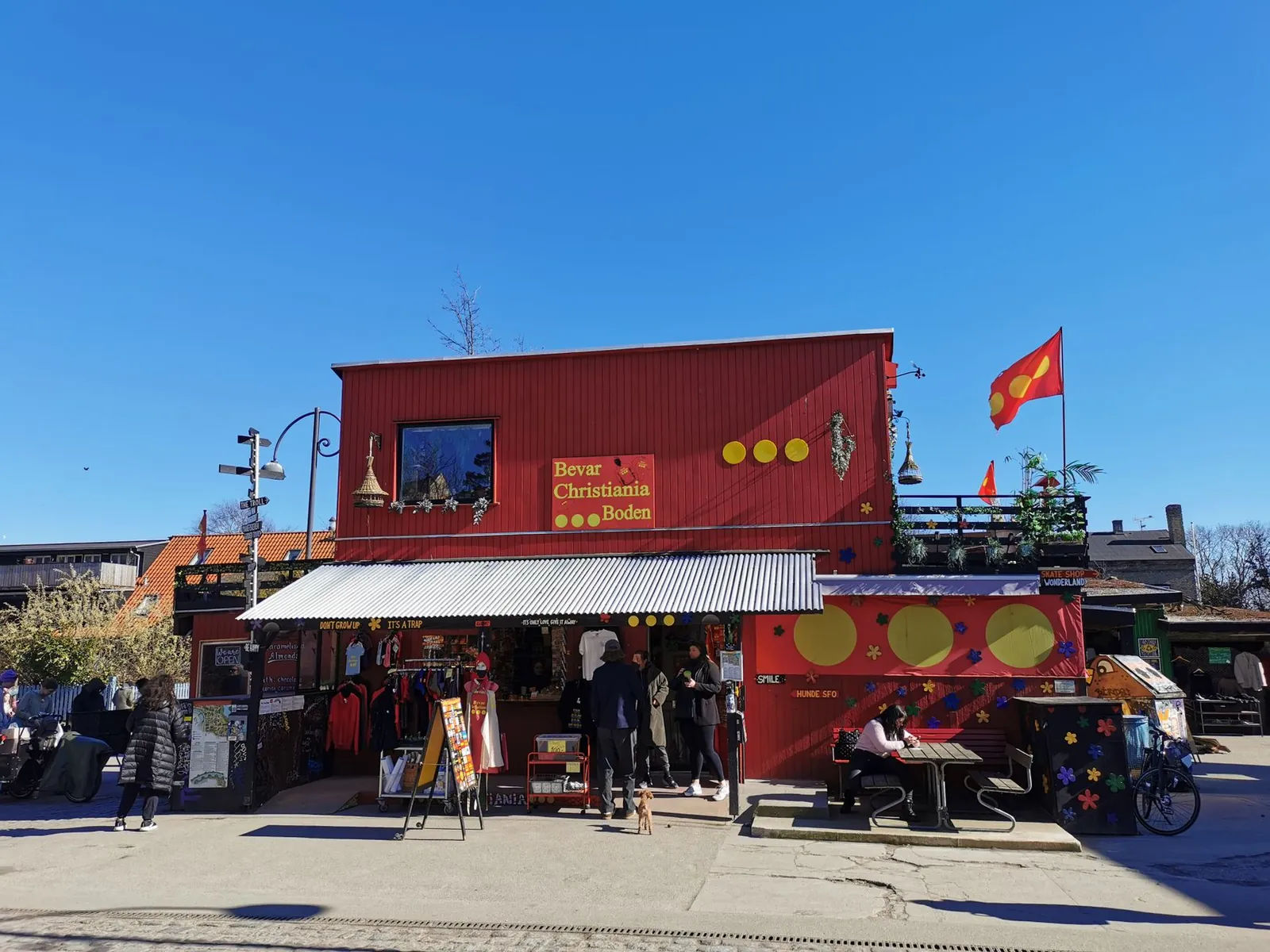
Christiania is safe to visit in daylight, free to enter, and no longer the open hash market it was famous for. Residents dug up Pusher Street themselves in April 2024 and the gang-run stall trade has not come back. Individual dealers do still operate discreetly, and it is worth being clear-eyed about that. Come for the self-built architecture, the music venues and the rampart walk, not for the drugs.
It sits inside the Christianshavn district, and it is one of the more complicated entries in our roundup of Copenhagen landmarks.
What Actually Happened to Pusher Street
This is where almost every other guide is out of date, in one direction or the other.
After a fatal shooting on 26 August 2023, the Christiania community voted that same weekend to close Pusher Street. On 6 April 2024 residents, politicians and supporters dug up the street’s cobblestones by hand with shovels and wheelbarrows. Anyone who turned up could take a cobblestone home.
An enhanced penalty zone covering the area ran from 10 January 2024 and was allowed to expire on 10 January 2025 without renewal. Copenhagen Police said at the time that organised drug crime and the biker and gang groups were gone, and that the area was increasingly perceived as calm. They reserved the right to reimpose it.
The numbers back that up. Charges for buying and selling narcotics at Christiania fell from 1,677 in 2024 to 552 in 2025. In the five months after the closure, monthly charges dropped from 97 in April to 4 in August. A senior vice police inspector put it plainly: the organised hash trade of 35 stalls no longer exists.
But it has not vanished entirely. In January 2026 a Danish television reporter walking the former Pusher Street on a weekday afternoon was offered hash twice within five minutes, and on a second visit bought some for 100 kroner, retrieved from under a paving stone. Christiania’s own spokesperson said she was frustrated and that after dark it can feel unsafe. Copenhagen Police described it as opportunistic and unorganised, nothing like the stalls, masked men and gang symbols of before.
So the honest position, which sits between the two things you will read elsewhere: the organised market is gone and has not returned. Opportunistic individual dealing persists, hidden in corners, and it is worst after dark. Anyone telling you the drug trade is over, or that Pusher Street is back, is wrong in one direction or the other.
The Rules, and Which Ones Still Apply
The famous three rules, posted on a sign at the entrance to Pusher Street, were have fun, no photos and no running. They were rules of that street, never of Christiania as a whole.
The photography ban has been lifted. Danish public broadcaster DR reported in April 2025 that filming and photography on the street, previously forbidden, are now allowed, and quoted police filming there themselves. Half the guides online still tell you not to take your phone out. They are describing a market that no longer exists.
No running was a rule with a purpose: running signalled a police raid and caused panic. It is now historic.
The ban on hard drugs is the one rule the community has enforced consistently since the Junk Blockade of 1979, and it still stands.
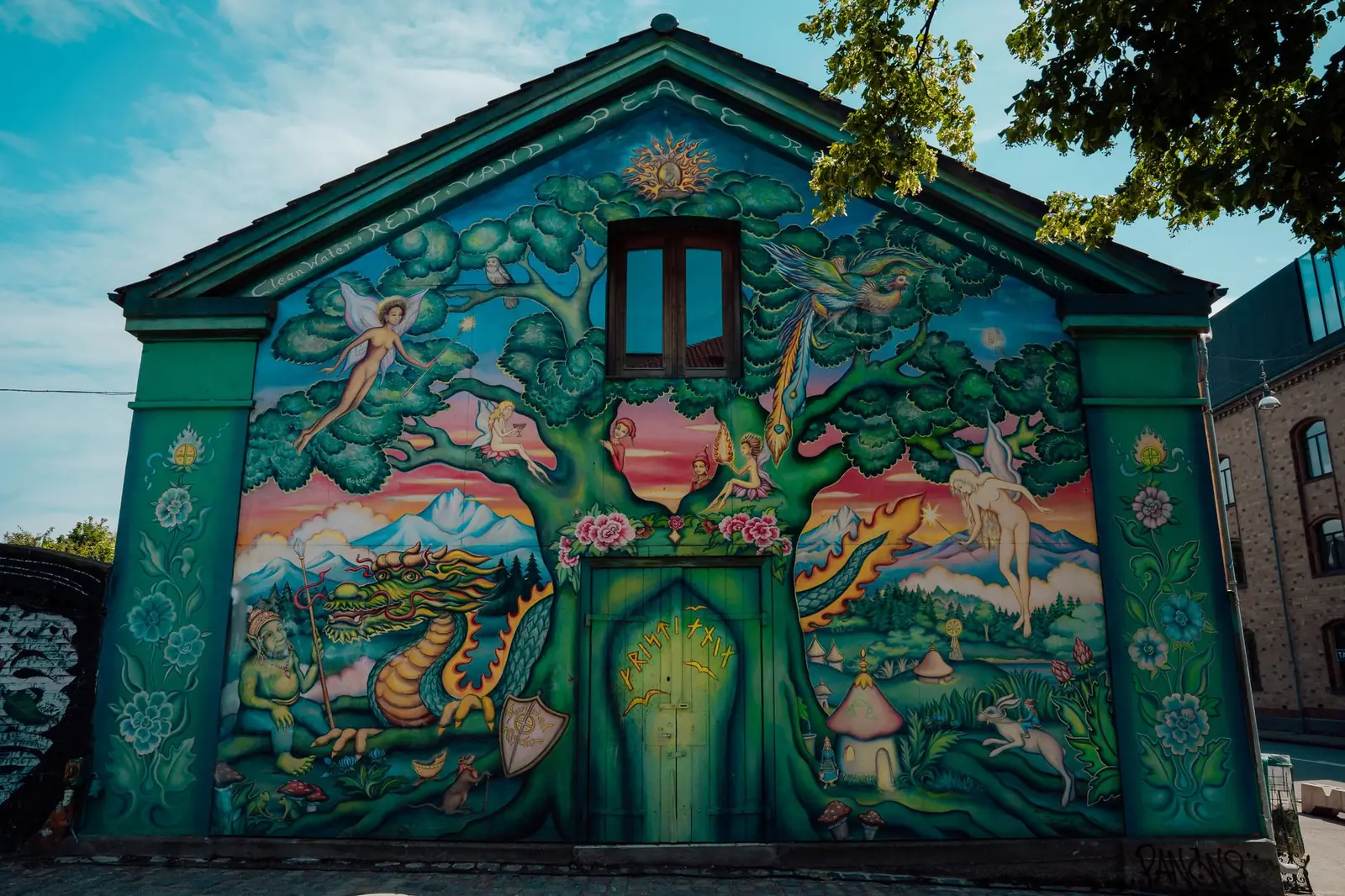
What replaces the rest is ordinary courtesy. This is a residential neighbourhood where roughly a thousand people live, about 130 of them children. Do not photograph people or their homes without asking, do not wander into gardens, and do not treat it as a theme park. Christiania’s own welcome sign asks visitors to be quiet in the nature, respect the residents and use the bins, which is about the right register.
Is It Legal? And What Is the Actual Risk?
Cannabis is illegal in Denmark, and it is illegal in Christiania. It always has been. What Christiania had was a tolerated illegal trade, not a legal one. VisitCopenhagen states it flatly on its own site.
Buyers are charged, not just sellers. In the years before the closure, annual charges ran to several thousand against buyers. Practically, possession of a small amount for personal use is a fine rather than a custodial matter for a first offence, but a street purchase at Christiania is exactly the transaction police still pick up.
The single behaviour that creates real risk for a visitor is buying. Every documented problem flows from taking part in an unregulated illegal transaction with a stranger who is hiding from the police. Walk past, say no thanks, and there is very little that can go wrong here.
Is Christiania Safe?
Daytime: yes, comparable to any other Copenhagen neighbourhood, with the caveat that you may be approached and offered something. A short no and keep walking is the whole strategy.
With children, in daylight: fine. There is a skate park, a children’s theatre, a nature area and, in winter, an ice rink.
In the evening: the venues are genuinely part of Copenhagen’s cultural life and worth going to. But the unlit paths and quiet corners are where the residual dealing happens. Stick to the lit routes between venues and the main entrance, and do not wander the ramparts alone at night. Christiania’s own spokesperson has said it can feel unsafe after dark, which is a more candid assessment than the official tourism copy offers.
For context on how much has changed: police now walk and film there routinely, something an inspector described in 2025 as unthinkable a year earlier.
What to Actually See
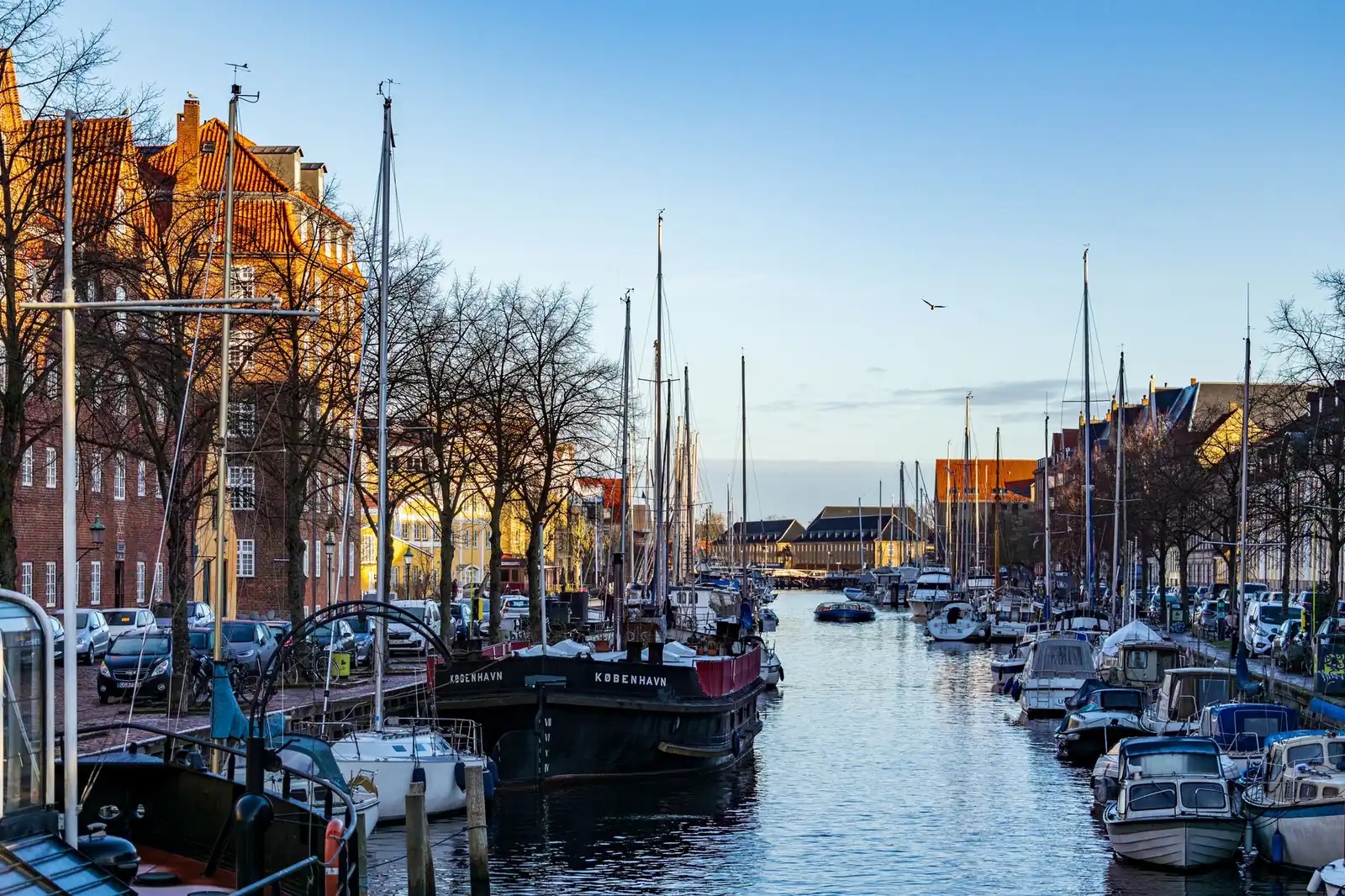
- Christianshavns Vold, the ramparts. The most under-covered thing here and, we would argue, the best. Seventeenth-century fortification earthworks with old chestnut trees, winding paths between bastions, viewpoints over the Stadsgraven and the lakes. It is a protected monument, so nothing new can be built on it. Allow an hour.
- The self-built houses. The homes along the ramparts are the real architectural draw: owner-built, no two alike, and unlike anything else in Denmark. This is exactly where the courtesy about photographing people’s homes matters.
- Den Grå Hal, the former riding hall, used for concerts, flea markets, the Christmas market and the community’s own consensus meetings.
- Loppen, the live music venue, with tickets typically running about 110 to 300 DKK and doors around 19:00 to 21:00.
- Nemoland, the bar and outdoor stage, open until midnight most nights and 03:00 on Friday and Saturday.
- Café Månefiskeren for coffee, cake and board games, and Morgenstedet on Fabriksområdet for organic vegetarian food, usually two hot dishes for under 100 DKK. Morgenstedet is self-service and has historically closed on Mondays.
- Christianias Smedie, the forge where the Christiania cargo trike was invented and still a working workshop, plus Kvindesmedien, the women’s forge.
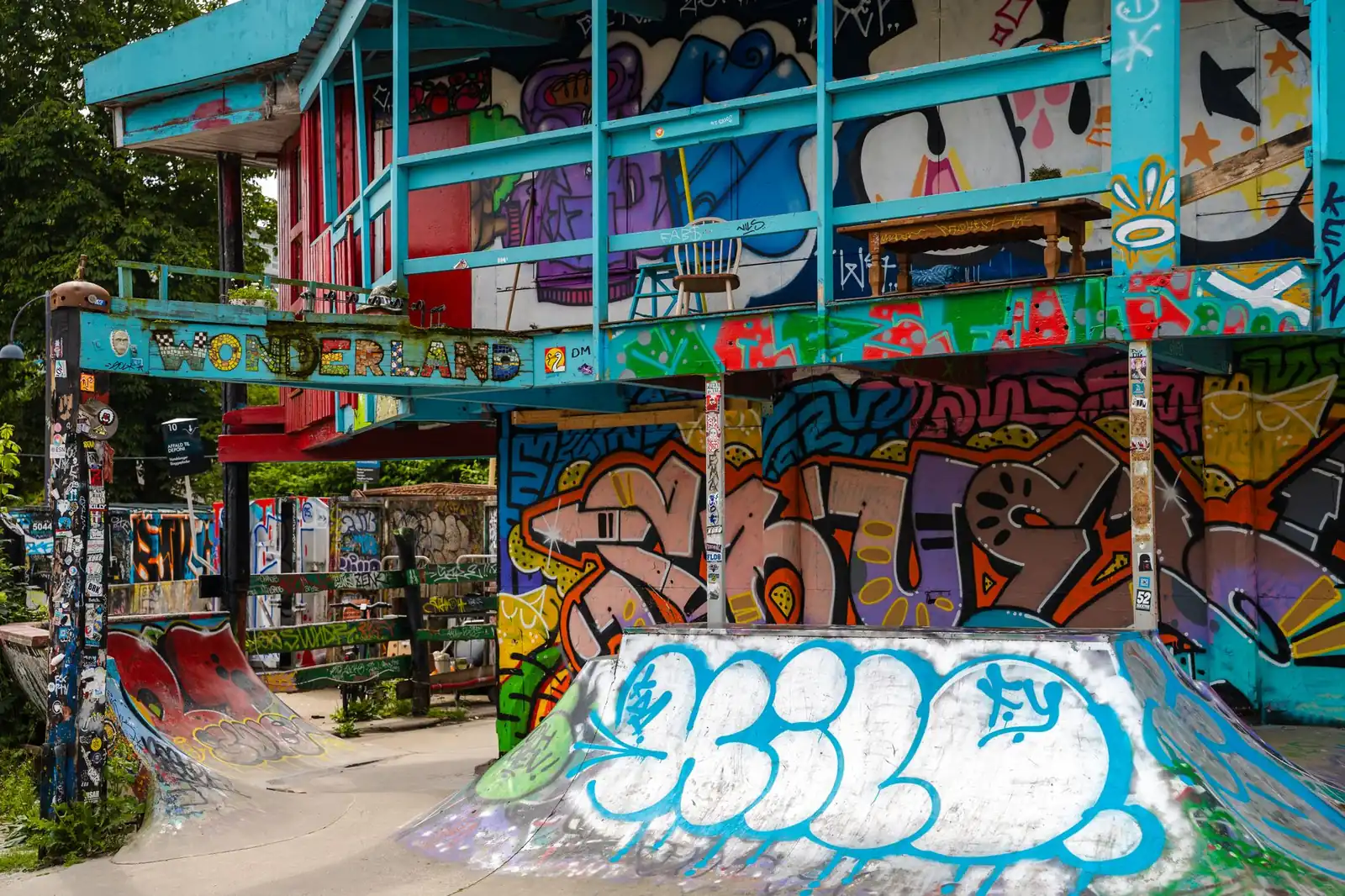
- ALIS Wonderland, the outdoor concrete skate bowl, and Gallopperiet, Christiania’s art space in the Loppe building.
- Christiania Bryghus for hemp-infused beer, and Den Grønne Genbrugshal, the salvage and recycling hall.
In winter there is now a 660 square metre ice rink installed on the former Pusher Street itself, running roughly from late November to early January. That is a genuinely new reason to come and almost nobody mentions it.
What you will not find, despite the plans: the dome, the ceremonial gates, the footbridge and the spiral viewing tower in the 85 million kroner redevelopment vision are proposed, not built. The cobblestones have been relaid and there are cafes, bakeries, craft shops and a Thomas Dambo troll sculpture. The rest is on paper.
Visiting in 2026 Means Seeing It Before It Changes
This is the story no travel guide is telling, and it is the strongest reason to go now.
In February 2026, a community meeting in Den Grå Hal approved working with Copenhagen Municipality on a local plan for 10,000 square metres of public housing around Pusher Street. Work on that plan formally began in May 2026. The site is the south-western quarter of Christiania, running from the Prinsessegade corner past the handmade main entrance up to Refshalevej, which is precisely the visitor-facing zone containing Den Grå Hal, Nemoland and most of the bars.
It means roughly 300 new residents, about 35 per cent population growth. The timeline runs to a preliminary report in mid-2027 and a final local plan going to politicians in the second quarter of 2028.
Whatever you think of it, what is there in 2026 will not be what is there in 2030. That is a genuine and honest argument for going now, and it has nothing to do with drugs.
A Short History
| Date | What happened |
|---|---|
| 26 September 1971 | Squatters occupy the abandoned Bådsmandsstræde barracks; journalist Jacob Ludvigsen declares the freetown open |
| 13 November 1971 | Residents adopt their own charter |
| June 1989 | The Christiania Law gives the area a legal basis |
| 2004 | The law is amended to bring Christiania under ordinary Danish planning rules |
| 18 February 2011 | The Supreme Court confirms the state owns the land |
| 1 July 2012 | Fonden Fristaden Christiania is established and begins buying, partly funded by public shares |
| August 2022 | Deal to buy the northern ramparts in exchange for accepting 15,000 m² of public housing |
| 26 August 2023 | Fatal shooting on Pusher Street; the community votes to close it |
| 6 April 2024 | Pusher Street is dug up by hand |
| February 2026 | Residents approve a plan for 10,000 m² of housing around the former street |
Roughly 850 to 1,000 people live across about 34 hectares including the ramparts. Sources disagree on the exact figures, and Christiania is not a place that lends itself to precision.
Practical Details
| Entry | Free. It is an open neighbourhood, not a gated attraction, with no ticket and no closing time |
| Nearest Metro | Christianshavn (M1/M2), 4 to 6 minutes’ walk to the Prinsessegade entrance |
| Walking from the centre | About 15 minutes from Nyhavn, 20 to 25 from Rådhuspladsen |
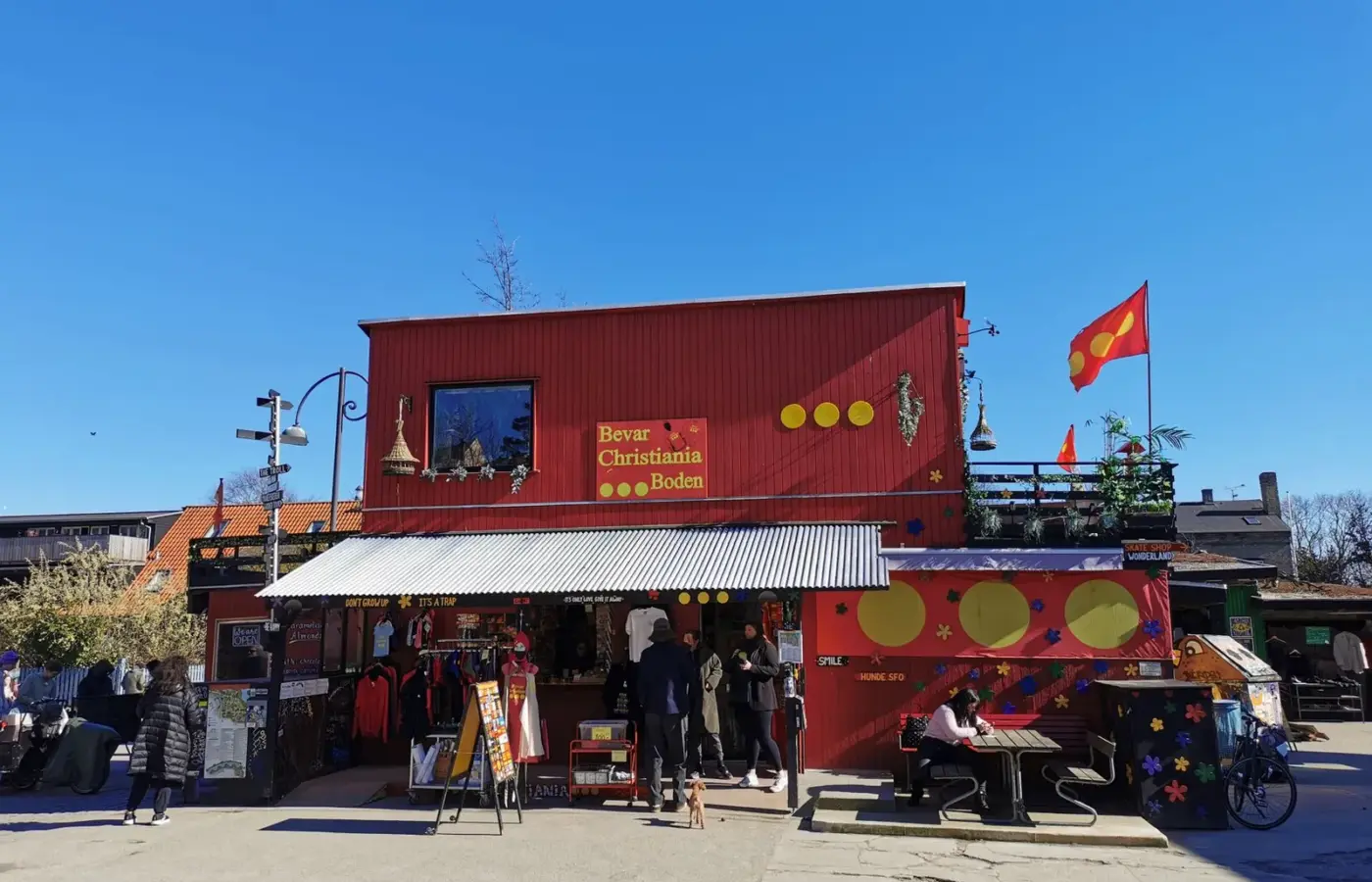
| Main entrance | The handmade gate on Prinsessegade, two wooden posts with a Christiania board between them |
| How long to allow | 2 to 4 hours including the ramparts walk |
| Payment | Card is widely accepted, but carry 200 to 300 DKK in cash for stalls and smaller cafes |
| Accessibility | Paths are unpaved, uneven and muddy in places, and the ramparts involve slopes and steps |
Guided tours. Every competing guide repeats a schedule of daily 3pm tours at 60 DKK. That is the old operator’s timetable and it no longer matches what is advertised. The resident-run Visit Christiania Freetown currently runs open walk-in tours on Sundays at 12:00 and 16:00, roughly two hours, meeting on the lawn by Den Grå Hal. Prices are 100 DKK for adults, 80 for pensioners, 50 for students, 40 for children aged 6 to 18 and free under 6, payable by card, MobilePay or cash. Ten per cent of guide fees go to Christiania’s common fund. Group tours can be booked separately. One caveat: the open Sunday tours may be seasonal, so check before you build a Sunday around it.
Christiania is effectively car-free and the residents intend to keep it that way, which is a live point of friction with the municipality’s parking requirements in the current planning work.
Who Should Go, and Who Should Not Bother
Go if you are interested in architecture, urbanism or how a thousand people have run a consensus democracy for 55 years. Go for the ramparts, which are the best green walk in central Copenhagen and have nothing to do with any of the above. Go for a gig at Loppen. Go because the place is about to change substantially.
Do not bother if you came to buy or smoke cannabis, which is illegal, policed and increasingly furtive, and is now the worst possible reason to visit. Do not bother if you expect a preserved Pusher Street spectacle, because it does not exist. And do not bother if you are on a tight one-day itinerary and would only give it twenty minutes; a walk-through is not worth the detour, but two hours is.
Frequently Asked Questions
Is Christiania safe to visit?
In daylight, yes. It is a residential neighbourhood and the organised drug trade that caused the violence is gone. You may still be offered drugs by individuals. After dark, stick to the lit routes between venues; Christiania’s own spokesperson has said the quieter corners can feel unsafe at night.
Can you still take photos in Christiania?
Yes. The photography ban applied to Pusher Street and was lifted after the street was closed, confirmed by Danish public broadcasting in April 2025. Ordinary courtesy still applies: do not photograph residents or their homes without asking.
Can you still buy cannabis in Christiania?
It is illegal, and the organised stall market was dismantled in April 2024 and has not returned. Individual dealers still operate discreetly. Buyers are charged as well as sellers, so this is the one thing that can genuinely spoil your trip.
Do you have to pay to enter Christiania?
No. It is free and open, with no ticket and no gate. Only the guided tours and the venues charge.
How do you get to Christiania?
Take the Metro to Christianshavn and walk four to six minutes to the Prinsessegade entrance, or walk about fifteen minutes from Nyhavn through Christianshavn.
Is Christiania worth visiting?
For the self-built architecture, the rampart walk and the music venues, yes, and two hours is about right. For the drug tourism it was once known for, no.
Can you visit Christiania with children?
In the daytime, yes. There is a skate park, a children’s theatre, a nature area and a winter ice rink, and about 130 children live there.
Related Reading
- How the city’s districts differ puts Christiania in context with the rest of Copenhagen.
- Refshaleøen, just up the road pairs naturally with a Christiania afternoon.
- Walking tours across the city covers the guided options beyond the resident-run tours here.
- Other things that cost nothing includes several within walking distance of the ramparts.
Final Thoughts
Christiania in 2026 is a more interesting place than it has been in years, and a less notorious one. The thing it was famous for is largely gone, the thing it is actually good at, which is fifty-five years of building your own house and running your own neighbourhood, is still there, and a substantial redevelopment is now under way that will change the most-visited part of it by the end of the decade. Give it two hours, walk the ramparts, buy a coffee at Månefiskeren, and do not buy anything from anyone loitering by a paving stone.
Last verified: September 2026, against Danish police, DR and TV 2 Kosmopol reporting from 2024 to 2026. Christiania changes quickly; check current tour times before relying on them.